

Percentage Decrease Calculator is a tool that helps you quickly find how much a value has gone down in terms of percentage. It shows the size of the drop from an original value to a new smaller value, making it easy to understand reductions in prices, scores, population, sales, and more. Instead of doing manual calculations, this tool gives instant results and shows how much something has decreased compared to where it started.
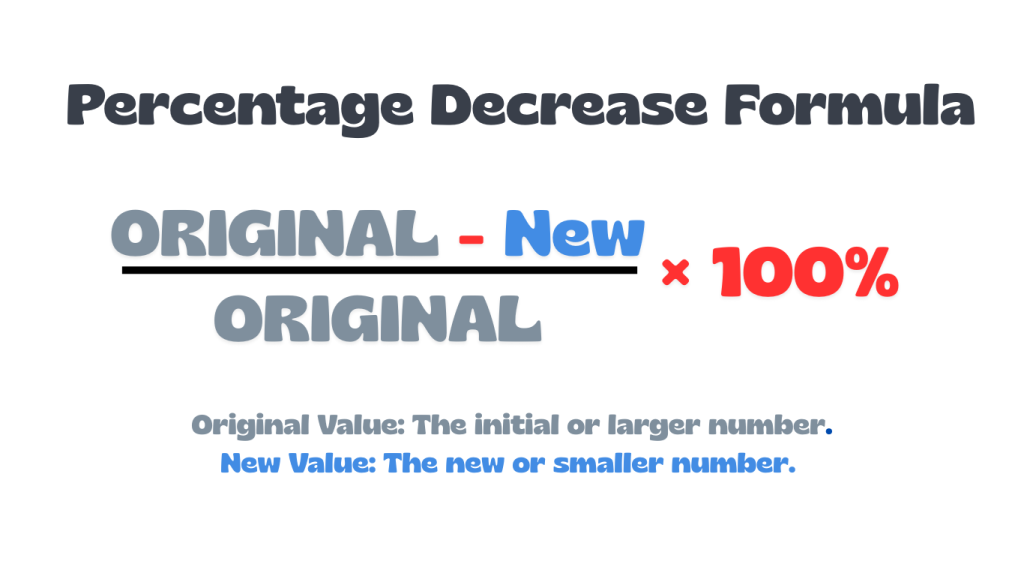
Quick answerPercentage decrease = (Original − New) ÷ Original × 100
Example: The price falls from $120 to $85.
(120 − 85) ÷ 120 × 100 = 29.17% decrease.
Table of Contents
What Is Percentage Decrease?
Percentage decrease is a type of measurement that is used to show how much a value has dropped compared to its original amount, which is shown as a percentage of the starting value. It indicates the scale of the loss in relation to the starting value instead of only displaying the numerical fall.
It is calculated by subtracting the new value from the original value, dividing the result by the original value, and then multiplying the result by 100. Price decreases, sales declines, population declines, and performance losses are all typically measured using this method.
Why Percentage Decrease Matters
The percentage decrease is an important method due to the fact that, rather than just showing a numerical value it shows how meaningful a drop is, not just how big it is in numbers. This improves the comparison of declines in different contexts, even when the values range widely in size.
A $50 drop on a $100 item is a 50% decrease, and the same $50 drop on $8000 item is 0.625% decrease which is barely noticeable. Percentage decrease matter because you see how meaningful the drop is and it supports in better analysis, cleaner comparisons, and making better decisions.
Percentage Decrease Formula
If you want to have a better understanding of percentage decrease, first we need the formula to compare the size of the drop with the original and new values. The image below shows the formula which is used in our percent decrease calculator, and the next section walks through it step by step.
How to Calculate Percentage Decrease (Step-by-Step)
To calculate percentage decrease between two numbers, follow the simple steps below :
- First subtract the new value from the original value.
- Secondly, divide the results by the original value.
- Finally, multiply by 100 to convert to a percentage.
Real-World Examples of Percentage Decrease
The examples below use the same formula and steps. In each one, the result shows how big the drop is compared with the starting value, not just how many units were lost. Enter the numbers into the percentage decrease calculator above to check that you get the same result.
Example 1Shopping (Price Drop)
Situation: A pair of running shoes cost $140 last month and now costs $98. What is the percentage decrease?
Step-by-Step Calculation:
- Subtract the new price from the original
140 − 98 = 42 - Divide by the original price
42 ÷ 140 = 0.30 - Multiply by 100
0.30 × 100 = 30%
Result: the price decreased by30%
Example 2Business & Finance (Falling Sales)
Situation: A small café sold 1,250 coffees in March and 1,075 in April.
Step-by-Step Calculation:
- Subtract the April coffees from March
1,250 − 1,075 = 175 - Divide by the original
175 ÷ 1,250 = 0.14 - Multiply by 100
0.14 × 100 = 14%
Result: sales fell by 14%
Example 3Data & Science (Population Counts)
Situation: A pond survey counted 480 frogs last year and 396 this year.
Step-by-Step Calculation:
- Subtract this years count from last years
480 − 396 = 84 - Divide by the original
84 ÷ 480 = 0.175 - Multiply by 100
0.175 × 100 = 17.5%
Result: the frog count decreased by 17.5%
How to Decrease a Number by a Percentage
To decrease a number by percentage, can be used two simple methods, one is the two step subtraction or the direct one step multiplication method. Each of the methods are explained below along with an example.
Method 1 Two-Step Method (Find and Subtract)
Steps:
- Find the percentage of the original number by multiplying the number by the percentage (expressed as a decimal or fraction).
- Subtract that result from the original number.
Example: Decrease 80 by 20%
Find 20% of 80: 80 × 0.20 =16
Subtract from the original 80 – 16 = 64
Method 2One-Step Method (Direct Multiplier)
Steps:
- Subtract the percentage from 100% to find out what percentage of the original number remains.
- Convert that remaining percentage into a decimal by dividing by 100.
- Multiply the original number by that decimal.
Example: Decrease 80 by 20%
Remaining percentage: 100% – 20 % = 80%
Convert to decimal: 80 ÷ 100 = 0.8
Multiply by the original number: 80 × 0.8 = 64
Loss-Recovery Table
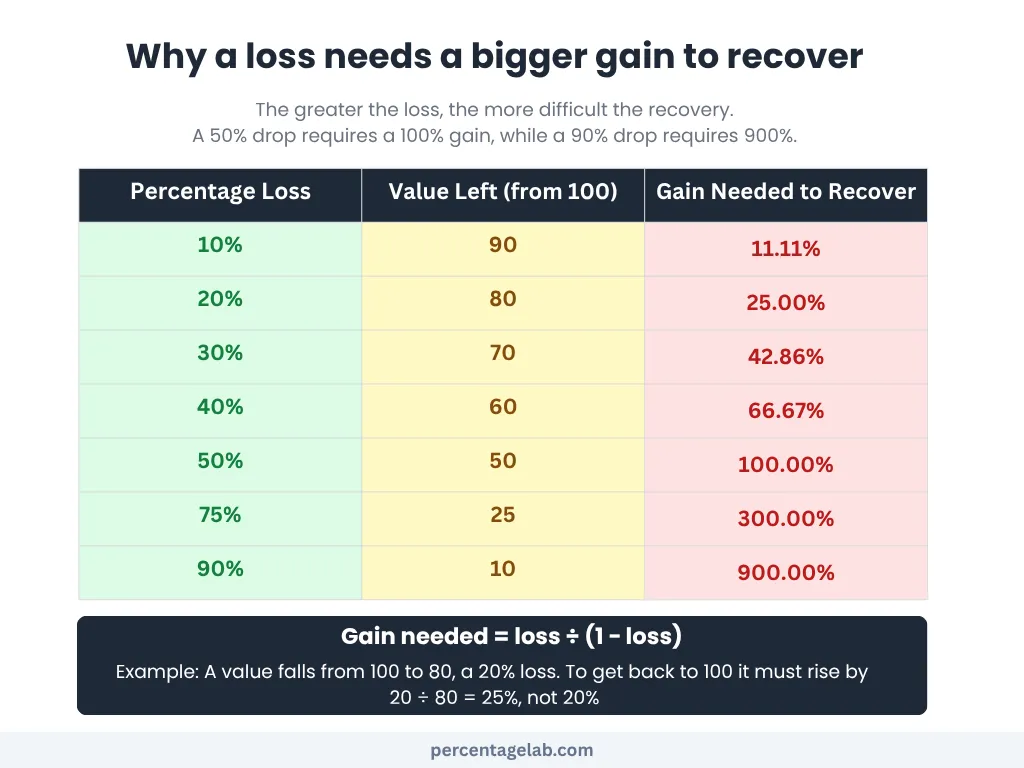
A decrease needs a bigger gain because percentage decrease and gain are calculated from two separate base values. Percentage loss is calculated from the original or starting value. While, the percentage gain is calculated from new or smaller remaining value. Below, you have a table to understand better the difference between percentage loss and what it needs to be recovered.
Percentage Increase vs. Percentage Decrease
A percentage decrease indicates how much a value has decreased from its initial value, and a percentage increase indicates how much a value has increased relative to its initial amount. The final result depends on whether the final value if it is larger or smaller, but both calculations use the initial value as the base. In simple words, percentage increase has the final value greater than the original one, which results in a positive percent, and the percentage decrease has the final value smaller than the original, which results in a reduction expressed as a percentage. The most important part for both of them is that the original value is always used as the divisor.
Percentage Decrease vs. Percentage Points
As we have mentioned before, percentage decrease describes how much a value has dropped compared to its original value. On the other hand, percentage points show a simple difference between two percentages. They do not calculate relative change they only show the difference between two percentages, how far they are from each other. An example can be like if a rate drops from 8% to 6%, this is a 2 percentage point decrease, but a 25% decrease compared to its original value of 8%. If you don’t have a good understanding ( or confusing ) of these concepts can lead you to incorrect interpretations, especially in fields like finance, media reporting, statistics, and more.
Quick ruleUse percentage decrease for changes in values (prices, sales, quantities).
Use percentage points when comparing percentages (rates, ratios, proportions).
Common Mistakes to Avoid
One of the most common mistakes when calculating percentage decrease is using the incorrect base value. When you apply the formula you should always divide the change of the original value, not the new value. Another common mistake is stopping in decimal number result and skipping or forgetting to multiply it by 100 that converts it to a percentage.
In cases when the result is a negative number, in general it is misunderstood, actually that number indicates a increase not decrease. In the previous section that we discussed about percentage point versus decrease, you should keep in mind that you can’t confuse them especially when comparing values that are already percentages.
Another thing to keep in mind that lead to an error is that percentages should not be added or subtracted when they apply to different base values. To ensure accurate results and calculation each change should be calculated from its accurate and true whole.
Frequently Asked Questions (FAQs)
Can a percentage decrease be greater than 100%?
Usually, no. In real-life situations like prices or quantities, something cannot drop by more than 100% because that would make it less than zero. A 100% decrease simply means the value becomes zero.What is a “starting value”?
The starting value is the amount you began with before the decrease happened. For example, if a product price went from $500 to $450, the starting value is $500.How do I calculate a 20% decrease on a calculator?
Find 20% of the original value (multiply by 0.20), then subtract it from the original number. Another quick way: multiply the original value by 0.80, since 80% is what remains after a 20% decrease.What is the most common mistake when calculating decrease?
A very common error is dividing by the new value instead of the original value. For percentage decrease, the original value must always be the base.Is a 50% decrease followed by a 50% increase the same as the original value?
No. If 100 becomes 50 (50% decrease) and then 50 increases by 50%, you get 75 not 100. The base changed after the first calculation.Why do I always divide by the original value?
Percentage decrease measures how much something dropped compared to where it started. Using the new value would give a completely different result.Is “percentage loss” the same as “percentage decrease”?
Yes. In finance and shopping, “percentage loss” is just another term for percentage decrease.Is “percentage off” the same as “percentage decrease”?
Yes. Terms like “discounted,” “reduced by,” or “price off” all describe percentage decrease.Can I calculate a percentage decrease if the initial value is negative?
Yes, but you need to be careful with negative numbers. Use the absolute value of the starting number when calculating the percentage.What does a 0% decrease mean?
It simply means nothing changed. The starting and ending values are the same.Explore More Percentage Tools
Explore more percentage calculators to help with different types of percentage problems from our site. Our tools are designed to make it easy to work out with percentage increase, decrease, change, difference, and much more tools that are only related to percentage calculations. Click any calculator below to continue solving percentage questions quickly and accurately.
Percentage Increase Calculator
Measures how much a value has gone up from its original amount, expressed as a percent.
Percentage Change Calculator
Finds how much a value has increased or decreased from its original value in percentage terms.
Percentage Difference Calculator
Calculates the percent difference between two numbers by comparing how far they are from each other.
References & Sources
To provide 100% accuracy and precision for the calculations performed by our tool, along with the formulas, calculation methods, real-world examples, and educational content included in this article, all information is verified and based on the following authoritative resources:
- Study.com – Percent Decrease Formula & Calculation
- BBC Bitesize – Percentage Decrease Guide
- Indeed Career Guide – How to Calculate Percentage Decrease
- BBC Bitesize – How to decrease an amount by a percentage
- SkillsYouNeed – Percentage Change | Increase and Decrease
- Mometrix – Percent Change Overview