

Use this percentage difference calculator to find how far apart two numbers are, as a percentage. Enter both values to get the percentage difference. It works when neither number is the “original”, for example when comparing two prices, two measurements or two scores. Below the tool you’ll find the formula, worked examples and how percentage difference differs from percentage change.
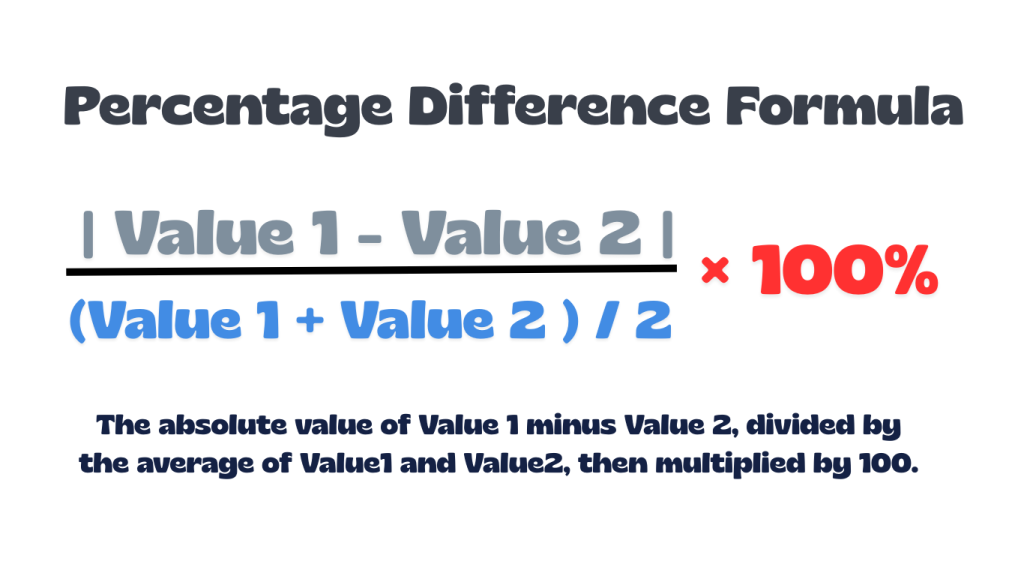
Quick answerPercentage difference = |V1 − V2| ÷ ((V1 + V2) ÷ 2) × 100.
Example: for 20 and 30, the difference is 10 and the average is 25, so 10 ÷ 25 × 100 = 40%.
Table of Contents
What is Percentage Difference?
Percentage difference shows how far apart two values are compared with their average, expressed as a percentage. To calculate it, we take the absolute difference between the two numbers, then divide it by their average, and in the end multiply it by 100. To use this method in the best way, the values are good to be equally important.
Percent difference is always a positive number and just illustrates how different the numbers are, in contrast with percentage change that shows if the value has increased or decreased based on the initial value. When comparing two identical quantities, such as pricing, measurements, or experimental results, it is a very helpful method.
Why Percentage Difference Is Important
Because it provides real context rather than just a simple subtraction, the percentage difference is important because it illustrates how far apart two values are from their average. A difference of 10 means very little between 1,000 and 1,010, but a lot between 5 and 15, and the percentage shows that.
Percent difference it simplifies the comparison between them and various sizes, and is especially helpful when neither value is a clear “starting” point. This method is helpful in different fields like science, business, economics, and everyday life. Also, it treats both of the numbers equally, so the comparison can be fairer and not one-sided. .
Percentage Difference Formula
The percentage difference formula compares the gap between two values with their average. The result is always positive, because it shows how far apart the values are, not which one is larger. The image below shows the formula which is also used in our percentage difference calculator, and the next section walks through it step by step.
How to Calculate Percentage Difference (Step-by-Step)
To calculate the percentage difference between two numbers, we need to use the formula and to follow the simple steps below:
- First, we find the absolute difference by subtracting the second value (V2) from the first value (V1).
- Then, calculate the average of the two numbers, we add the two values together and divide by 2.
- After that, divide the absolute difference by the average, basically we take the result from Step 1 and divide it by the result from Step 2.
- Finally, we convert to a percentage by multiplying the decimal result by 100 and adding a % sign.
Percentage Difference Examples
The examples below use the same formula and steps. In each one, the result shows how far apart the two values are compared with their average, and it is always a positive number. The order of the values doesn’t matter, so you get the same result whichever one you enter first. Enter the numbers into the percentage difference calculator above to check that you get the same result.
Example 1Shopping (Comparing Prices)
Situation: Store A sells a jacket for $48 and Store B sells the same jacket for $60. What is the percentage difference between the two prices?
Step-by-Step Calculation:
- Find the absolute difference
|48 − 60| = 12 - Find the average of the two prices
(48 + 60) ÷ 2 = 54 - Divide the difference by the average
12 ÷ 54 = 0.2222 - Multiply by 100
0.2222 × 100 = 22.22%
Result: the percentage difference between the two prices is 22.22%
Example 2Education (Test Scores)
Situation: Two students scored 65 and 85 on the same test. What is the percentage difference between their scores?
Step-by-Step Calculation:
- Find the absolute difference
|65 − 85| = 20 - Find the average of the two scores
(65 + 85) ÷ 2 = 75 - Divide the difference by the average
20 ÷ 75 = 0.2667 - Multiply by 100
0.2667 × 100 = 26.67%
Result: the percent difference between the two scores is 26.67%
Example 3Science (Lab Measurements)
Situation: Two measurements of the same metal rod are 9.8 cm and 10.2 cm. What is the percentage difference between the measurements?
Step-by-Step Calculation:
- Find the absolute difference
|9.8 − 10.2| = 0.4 - Find the average of the two measurements
(9.8 + 10.2) ÷ 2 = 10 - Divide the difference by the average
0.4 ÷ 10 = 0.04 - Multiply by 100
0.04 × 100 = 4%
Result: the percentage difference between the two measurements is 4%
Example 4Data (Population Counts)
Situation: Two towns have populations of 8,000 and 14,000. What is the percentage difference between their populations?
Step-by-Step Calculation:
- Find the absolute difference
|8,000 − 14,000| = 6,000 - Find the average of the two populations
(8,000 + 14,000) ÷ 2 = 11,000 - Divide the difference by the average
6,000 ÷ 11,000 = 0.5455 - Multiply by 100
0.5455 × 100 = 54.55%
Result: the percent difference between the two populations is 54.55%
Percentage Difference vs. Percentage Change
The percentage difference is when two values are compared using their average as the base and always results in a positive number, which doesn’t have a direction. On the other hand, percentage change takes in comparison two values which are the final value and the original one, and for these values it shows the direction with a positive (which is an increase) and negative ( which is a decrease) result. Use percent difference when you need to compare two similar values, like prices of two brands, and use percentage change when you are evaluating how much something has grown or fallen over time, like sales in stock.
When to Use Percentage Difference
Percentage difference can be used to compare two similar values that are neither the original nor the new value. Because it compares two values equally and uses their average as a reference, it is a helpful method to use for measurements, prices, scientific results, or any other similar situation when the order of numbers doesn’t matter.
For cases when you don’t care which value is the first but you only need to know just how far apart the two values are, it is a very useful method. Due to the fact that it evaluates both numbers equally rather than favoring one as the beginning point, it provides a clear and fair comparison.
Common Mistakes to Avoid
When calculating percentage difference, it’s easy to make mistakes. To ensure your manual calculations are accurate, keep these common mistakes in mind:
- Confusing it with percentage change: Don’t use one of the values as the base. Percent difference always uses the average of the two numbers.
- Wrong Base/Denominator: Always divide by the average of the two values, not just one of the values.
- Forgetting absolute value: Always use the absolute value (|Value 1 – Value 2|) to prevent unexpected negative results.
- Forgetting to multiply by 100: The division gives a decimal, so multiply by 100 to get a percentage.
- Order of operations errors: Always subtract first, divide by the average second, and multiply by 100 last.
- Rounding too soon: Keep your decimal values intact until the very final step to avoid compounding inaccuracies.
Percentage Difference FAQs
Why doesn’t the order of the numbers matter?
The formula uses the absolute difference and the average of the two numbers, so you get the same result no matter which value you type first. Swapping the inputs will not change the percentage difference.
Can the percentage difference be negative?
No. Percentage difference is always a positive value because it measures how far apart two numbers are, not whether one increased or decreased.
Can the percent difference be more than 100%?
Yes. It exceeds 100% when the gap between the two values is greater than their average. For example, 5 and 45 give 40 ÷ 25 × 100 = 160%. For values that are zero or positive, the maximum is 200%, which happens when one of the values is 0 (0 and 10 give 10 ÷ 5 × 100 = 200%).
Why does the formula use the average of the two values as the denominator?
The average is a fair middle value between both numbers, so neither one is treated as the “starting” value. For 20 and 30, dividing the difference (10) by 20 gives 50% and dividing by 30 gives 33.33%, but dividing by the average (25) gives 40% whichever value you enter first.
What does a 0% percentage difference mean?
It means the two values are equal. There is no gap between them, so the percentage difference is 0%.
What is the difference between percentage difference and percent error?
Percent error compares a measured value with a known or accepted value: |measured − accepted| ÷ |accepted| × 100. Percent difference compares two values when neither is the “correct” one, using their average as the base. For example, a measurement of 9.8 cm against an accepted value of 10 cm has a percent error of 0.2 ÷ 10 × 100 = 2%.
Can I use this calculator for more than two numbers?
This calculator compares two values at a time. To compare several numbers, calculate the percent difference for each pair separately.
Can I use percentage difference with negative numbers?
The formula is designed for values that are zero or positive, such as prices, measurements and counts. With negative values, the signs change the average, so the result can be misleading, and it is undefined when the average is 0 (for example with −10 and 10). If you need to compare negative values, look at the absolute difference as well.
When should I use a percent difference calculator?
Use it when you want to compare two similar values and neither one is a “starting” value, without focusing on an increase or decrease. For example, comparing prices at two stores, two test scores, two measurements or the populations of two towns.
Explore More Percentage Tools
Explore more percentage calculators to help with different types of percentage problems from our site. Our tools are designed to make it easy to work out with percentage increase, decrease, change, difference, and much more tools that are only related to percentage calculations. Click any calculator below to continue solving percentage questions quickly and accurately.
Percentage Increase Calculator
Measures how much a value has gone up from its original amount, expressed as a percent.
Percentage Decrease Calculator
Measures how much a value has gone down from its starting amount as a percentage.
Percentage Change Calculator
Finds how much a value has increased or decreased from its original value in percentage terms.
References & Sources
To provide accuracy and precision for the calculations performed by our percentage difference calculator, along with the formulas, calculation methods, real-world examples, and educational content included in this article, all information is verified and based on the following authoritative resources:
- Math Is Fun – Percentage Difference.
- Cuemath – Percent Difference.
- North Carolina State University – Percent Error and Percent Difference
- Moorpark College – Chemistry M01A Laboratory Manual, Experiment 1: Measurements and Statistical Analysis of Data
- SUNY Geneseo (Milne Publishing) – Appendix C: Writing Tips for Discussing Results