

Percent error is a useful way to measure how close your result is to the true or accepted value. This percent error calculator helps you quickly find the error between a measured (experimental) value and the true value, showing how large the difference is in terms of percentage. It’s commonly used in science, engineering, and everyday estimation to check accuracy, evaluate methods, and spot possible mistakes in measurements. Just enter your measured and true value, and the calculator will instantly compute the percent error for you.
Note before using the tool: The Measured Value is often called the experimental or observed value, while the True Value is commonly referred to as the accepted, actual, or theoretical value.
What is Percent Error?
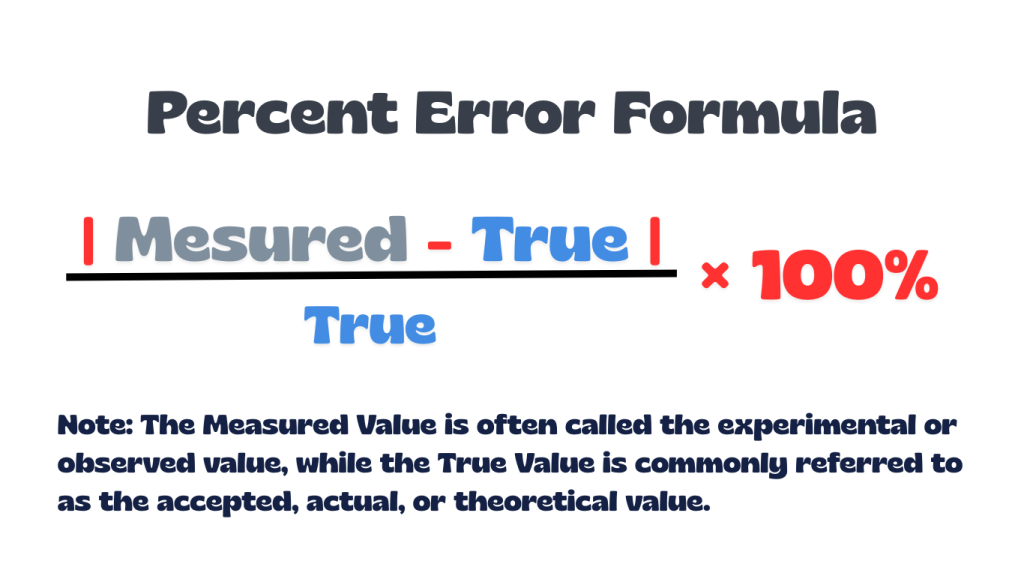
The percentage error indicates how much close is measured or estimated value to a real or accepted value. Percent error is calculated by finding the absolute difference of the experimental and theoretical value, then dividing the result of absolute value by theoretical value and in the end multiplying by 100. When the results is a large percent error it indicates a greater deviation and when it is a small percent error it indicates an accurate result.
These method is commonly used in fields like science or different studies (or experiments) to evaluate and judge how much accurate and reliable the results are. The main focus of percent error is accuracy, no the consistency of repeated measurements. For these method so you can calculate it accurately and with no math you have the percent error calculator.
Why Percent Error Matters
The importance of percent error is in its ability to provide a consistent and precise method for evaluating the accuracy of a measurement or estimation in relation to a known real number. It helps in determining the accuracy of the results and in cases when the large error points to problems with methods, tools or processes it identifies them. It provides additional meaning than absolute error alone since it expresses error in relation to the true value. In order to have better quality control and making well informed decisions these method is used in engineering, science, forecasting and manufacturing.
Percent Error Formula
How to Calculate Percent Error ?
In these example we will see and calculate percentage error step by step so you can have a much better understanding of it and the implementation of the formula. Also, in these example is also how our percent error calculator does the process.
Example: In these example is taken the length and measurement of a table
True Value: 120 cm ( the true length of a table)
Measured Value: 110 cm (your measurement)
- Error: 90 cm – 100 cm = -10 cm.
- Absolute Error: |-10 cm| = 10 cm.
- Divide: 10 cm / 100 cm = 0.1.
- Percentage:1 * 100% = 10%.
Positive vs Negative Error
Negative error happens when the measured value is lower than the true value, and positive error happens when the measured or experimental value is higher than the real or accepted value. Positive error indicates overestimation and negative error indicates underestimate in scientific measurements.
In different fields the concept of positive and negative results is commonly used, For example/, when testing hypothesis, in false positive or negative situations that describes incorrect test results, or in software testing when positive testing means and verifies the expected behavior and negative testing tells how the system has handled errors or unexpected inputs. These concepts we have explained and described are to have better understanding and so you can have do the right usage or our percent error calculator.
Positive error: measured value > true value
Negative error: measured value < true value
Absolute Error vs Relative Error
Absolute error is a difference between an estimated or measured value and the true value, that are expressed in the same units. It shows the size of the error. While, relative errors is the absolute error divided by the real value, which is often given as a percentage. It provides comparisons across multiple scales by displaying the error’s size in relation to the measurement.
When Percent Error is High or Low
The high accuracy of test is shown by a low percentage error, which means the measured value is quite near to the real value. These results are perfect for a reliable measurement, lab work, and for studies or experiments.
On the other hand, a low accuracy is indicated by a high percentage error, which shows an important deviation from the real value and may point to problems with processes, tools, computations, or assumptions. Percent error uses the absolute value to focus on the size of the deviation, regardless of direction like shown in the note before for positive and negative errors.
Keep in mind:
Low Error: Good, accurate, reliable.
High Error: Bad, inaccurate, needs investigation.
Common Causes of Percent Error
Error can be systematic that are constant bias, random which are unpredictable changes or gross that clear errors. These types of percentage errors can occur in measurement or experiments, and they can happen from different sources that some of them are listed below.
- Human and procedural factors: Which include multitasking, exhaustion, stress, lack of training, poor communication, unclear or inconsistent processes, and distractions.
- Instrument and data problems: Include inaccurate or missing data, zero mistakes, device limits, and faulty calibration.
- Environmental factors: Include variations in humidity or temperature, tremors, and outside disturbance.
Difference Between Percent Error, Percent Difference, and Percent Change
Percentage error, difference, and change are all related to percentage, and they take two values into comparison but they main difference is what they compare. Below you will have a description for each of them to understand how they differ from each other and their main purpose.
- Percentage change: It measures the increase or decrease of the original and new value , and also tracks the direction.
- Percentage error: Compares a measured or estimated value to a known true value, showing accuracy.
- Percentage difference: Treats two numbers equally and compares them to their average without assuming a “true” value.
Real-Life Examples
Percentage error can be found in any measurement and estimation when comparing the real value. Below you have some examples when it determines the difference between a predicted and actual value in real life situations. These situations can be applied in the percent error calculator.
- Science & Engineering: When measuring the speed of sound in physics experiments, comparing predicted vs. actual chemical yields, or calibrating scales (e.g., 24.9 g measured vs. 25 g true → 0.4% error).
- Commerce & Manufacturing: Product labeling errors (10.3 oz vs. 10 oz → 3%), cost estimates, or machine-produced dimensions.
- Everyday Life & Planning: Event attendance estimates (15 guessed vs. 18 actual → 16.7%), guessing quantities or estimating nutritional portions.
How a Percent Error Calculator Works?
A percent error calculator determines how much accurate the measurement is by comparing the measured value with the true value. There are three main steps that also our percent error calculator does which will be described in the following sentences.
Firstly it takes the absolute error by subtracting the true value by the measured value. Then it calculates relative error by dividing the absolute difference with true value to show the size of the error in relation of the correct value. In the end it converts it to percentage by multiplying it by 100, which shows the size of error and gives in a better format to understand.
All the explanation is the implantation of the formula in the image shown in the above sections which is also is the same formula used in our percent error calculator.
Common Uses of Percent Error Calculator
The percentage error calculator is commonly used in comparing measured or prediceted values with known real values. They assist in determining the level of an error and the accuracy of the findings. A high percent error indicates that a result might need to be reviewed, while a low percent error indicates good accuracy. Below you have the list when they are commonly used.
- Science labs: Comparing proven theoretical values with experimental outcomes.
- Devices calibration: Testing the accuracy of measuring instruments.
- Method evaluation: Evaluating the reliability of new methods or approaches.
- Business and forecasting: Comparing predicted outcomes with actual results.
- Education: Assisting students in understanding precision in scientific and math challenges.
- Data analysis: Finding significant errors or mistakes in datasets.
Why to Use Our Percent Error Calculator
You may easily determine how near your estimated or experimental number is to the true value by using a percent error calculator. It displays the accuracy and reliability of the results as well as any potential issues with the methods, tools or assumptions. Below you will have a list on what makes the percentage error calculator a useful tool in science, engineering, education and more.
- Evaluate accuracy: Indicates the deviation between your result and the acceptable value.
- Validate experiments and procedures: Verify the accuracy of methods and equipments.
- Determine problems: Errors or inconsistencies that need to be fixed are highlighted with a high percent error.
- Makes standardized comparisons: By expressing error as a percentage, making result simplier for comparison in different scales.
- Check predictions: Assists in evaluating how closely a company or financial projection matches the real result.
Frequently Asked Questions (FAQs)
1. What is the difference between experimental value and theoretical value?
The experimental (measured) value is what you actually got from your test or calculation. The theoretical (accepted) value is the correct or expected value based on known information.
2. Can percent error be greater than 100%?
Yes. Percent error can be more than 100% when your measured value is far from the real value. For example, if the real value is 5 and you measured 20, the error is more than 100%.
3. What is considered a “good” percent error?
It depends on the subject. In most cases, less than 5% is very accurate. In school science labs, up to about 10% is usually acceptable.
4. Can percent error be negative?
Some formulas allow negative error to show whether your value is higher or lower than expected. However, most online calculators give percent error as a positive number because they use absolute value.
5. Why does the calculator show 0% error?
A 0% error means your experimental value and theoretical value are exactly the same, your result was perfectly accurate.
6. Is percent error the same as relative error?
They are related. Relative error is the error written as a decimal. Percent error is simply relative error multiplied by 100 to write it as a percentage.
7. They are related. Relative error is the error written as a decimal. Percent error is simply relative error multiplied by 100 to write it as a percentage.
Percent error cannot be calculated when the theoretical value is zero because this causes division by zero. In this case, other measures like absolute error are used instead.
8. When should I use a percent error calculator?
You can use it anytime you want to measure accuracy, for example, in science experiments, construction estimates, financial predictions, or checking measurement mistakes.
Explore More Percentage Tools
Explore more percentage calculators to help with different types of percentage problems from our site. Our tools are designed to make it easy to work out with percentage increase, decrease, change, difference, and much more tools that are only related to percentage calculations. Click any calculator below to continue solving percentage questions quickly and accurately.
Percentage Increase Calculator
Measures how much a value has gone up from its original amount, expressed as a percent.
Percentage Difference Calculator
Calculates the percent difference between two numbers by comparing how far they are from each other.
Percentage Change Calculator
Finds how much a value has increased or decreased from its original value in percentage terms.
REFERENCE
The percent error calculator on this page is based on standard mathematical definitions and explanations from trusted educational resources: