
A Decimal to Percent Calculator makes it easy to convert decimal numbers into percentages quickly and accurately. Instead of doing the math manually, simply enter a decimal value and get the equivalent percentage in one click. This tool is useful for everyday calculations, finance and interest rates, academic work, and understanding data such as growth, error rates, or probability. Whether you’re working with small decimals or values greater than one, this calculator helps you avoid mistakes and saves time.
OR
What is a decimal Number?
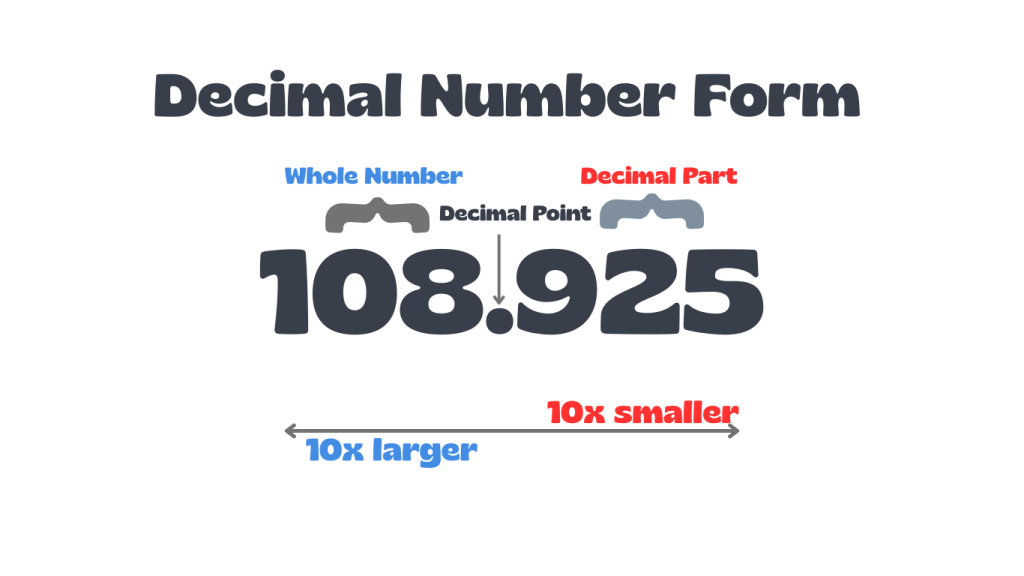
A decimal number shows pieces (or part) of a whole by using the decimal point to divide the whole number part from the fractional part. An example can be the number 32.84, where the 32 is the whole number part and the .84 is the fraction. By displaying values between different numbers such as 0.6 (sixth tenths) or 1.5 than can be said “one and a half” they provide more precision beyond whole numbers. All the numbers that follow after the decimal point part are represent as powers of 10 in the denominator. As an example can be the number 0.78, here the number 7 stands for seven-tenths and 8 stand for the eight-hundredths.
What Is a Decimal to Percent Conversion?
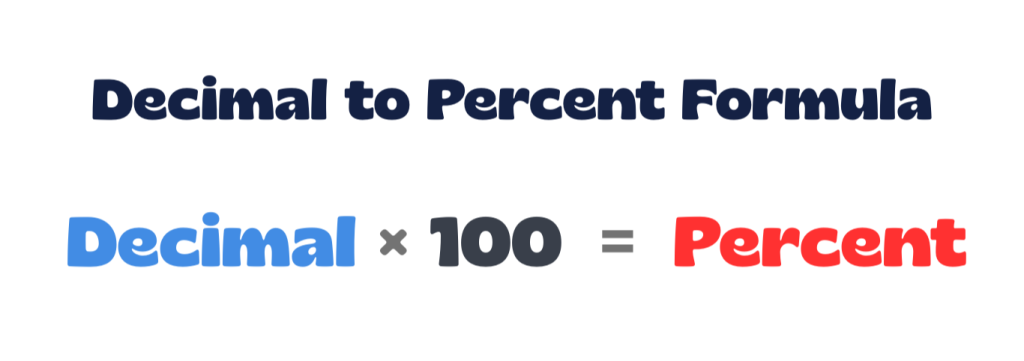
A decimal to percent conversion is the process that takes a number from its decimal form and changes it into a percent. An simple example can the number 0.35 and we multiply the decimal number by 100 , add the percentage sing and we get 35% . Also these process is the same thing as moving the decimal point 2 positions on the right. Since percent translates as “out of 100” this procedure displays the decimal as “parts per hundred”. Sometimes some decimal numbers can be long and confusing, but we done the decimal to percent calculator so you don’t have to do the math and get confused.
How Do You Convert Decimal to Percent
These is a very simple thing to do and easy to remember as we explained before. Below you have 2 ,simple method that helps you to have a better understanding how to do manually and by yourself. Also, after the method you will have the decimal to percent formula so you can have an illustration of it.
Method 1: We take the number 0.48. Firstly we multiply by 100, then we add the % sing and we get 48%.
Method 2: For these method you have to keep in mind that always move the decimal point two places to the right.
Decimal to Percent Formula
Step-by-Step Examples
Example 1: Simple Decimal -> 0.25
- Multiply by 100: 0.25 × 100 = 25.
- Add the % symbol: 25%.
Shortcut: Move the decimal point two places to the right: 0.25 → 25%. Can be used for all the examples also below .
Example 2: Decimal with a Zero -> 0.07
- Multiply by 100: 0.07 × 100 = 7.
- Add the % symbol: 7%.
- Shortcut: 0.07 → 7%.
Example 3: Decimal Greater Than One -> 1.23
- Multiply by 100: 1.23 × 100 = 123.
- Add the % symbol: 123%.
- Shortcut: 1.23 → 123%.
Example 4: Decimal with More Places -> 0.625
- Multiply by 100: 0.625 × 100 = 62.5.
- Add the % symbol: 62.5%.
- Shortcut: 0.625 → 62.5%.
Example 5: Small Decimal -> 0.006
- Multiply by 100: 0.006 × 100 = 0.6.
- Add the % symbol: 0.6%.
- Shortcut: 0.006 → 0.6%.
Common Mistakes to Avoid
One of the most common mistakes that is done when converting decimal numbers to percentage is to move the decimal points in the wrong way and forgetting to add the percent sing or to multiply by 100. Sometimes numbers are confused with each other like 0.5 with 0.05 in which they are 50% and 5%. Also a common one is not to realize that decimal number that are greater than 1 are percentages that go over 100% like 1.32 is equal to 132%. To avoid these mistakes is better to use our decimal to percent calculator and to see the examples above.
When to Use a Decimal to Percent Calculator
Use our decimal to percent calculator to quickly and accurately make the conversion of decimal numbers to percentages. It can be used for daily life or academic situations like calculating grades , profit margin, discounts, scientific data or when you are facing proportions. You can use our decimal to percent calculator when you need to understand a decimal number, or when it needs to be shown as part of a whole to have more easier comparisons and have better decision making. Out tool designed to be easy to use, save you time, removes errors particularly when dealing with complicated decimals or several conversions, and provides direct results.
Frequently Asked Questions (FAQs)
1. What happens if the decimal is greater than 1?
If the decimal is greater than 1, the resulting percentage will be over 100%. For example, 1.5 converts to 150%, which often represents growth or values exceeding the original amount.
2. How should repeating decimals be handled?
Repeating decimals can be shown in rounded form or with a repeating pattern. For instance, 0.333… becomes 33.3% when rounded or 33% with a repeating 3 if using mathematical notation.
3. Is there a quick way to convert decimals to percentages manually?
Yes. Simply move the decimal point two places to the right and add the percent sign. For example, 0.85 becomes 85%.
4.How do I convert a percentage back into a decimal?
Divide the percentage by 100, or move the decimal point two places to the left. For example, 25% becomes 0.25. Our use our Percent to decimal calculator.
5. How are decimals used in interest rates and finance?
In finance, decimals are commonly used to represent rates. For example, an interest rate of 0.07 is the same as 7%.
6. Does rounding affect the accuracy of the result?
Yes. Always convert the decimal to a percentage first, then round the final result. Rounding too early can lead to inaccurate percentages.
7. Are there any decimals that cannot be converted to percentages?
No. Any decimal number can be converted into a percentage by multiplying it by 100.
8. How do I convert a negative decimal to a percentage?
The process is the same, multiply by 100 and keep the negative sign. For example, -0.25 becomes -25%, often used to indicate a loss or decrease.
9. Can whole numbers be converted directly into percentages?
Yes. Whole numbers can be treated as decimals. For example, 5 becomes 500%, which represents five times the original value.
10. How is decimal-to-percent conversion used in percent error calculations?
In scientific calculations, percent error is found by dividing the error by the accepted value, resulting in a decimal that is then converted into a percentage (e.g., 0.05 becomes 5% error).
Explore More Percentage Tools
Explore more percentage calculators to help with different types of percentage problems from our site. Our tools are designed to make it easy to work out with percentage increase, decrease, change, difference, and much more tools that are only related to percentage calculations. Click any calculator below to continue solving percentage questions quickly and accurately.
Fraction to Percent Calculator
Changes any fraction into a percentage by converting the fraction to a decimal and multiplying by 100.
Percent to Fraction Calculator
Turns a percentage into a simplified fraction, helping you express percent values as ratios of whole numbers.
Percent to Ratio Calculator
Converts a percentage into a ratio format, showing how a value compares to the whole in simple terms.
Ratio to Percent Calculator
Transforms a ratio into a percentage by expressing one part of the ratio as a portion of the total.
REFERENCE
The Decimal to Percent Calculator on this page is based on standard mathematical definitions and explanations from trusted educational resources: