What Is Percent to Ratio Conversion?
Percent to ratio conversion is done by taking the percentage an changing it into a comparison of two numbers. These process is done by placing the percentage number over 100 and then simplifying that fraction. An example is when 75% becomes 75/100 and then simplify into ¾ or as a ratio 3:4. A percentage means “per hundred,” and a ratio shows the same relationship./
How to Convert Percent to Ratio
The conversion of percent to ratio is very simple process and easy to remember. Below you will have all the steps needed to do the calculation which also are the steps that our percent to ratio calculator does.
Steps to Convert a Percentage to a Ratio
- Remove the % sign: Start with the number only.
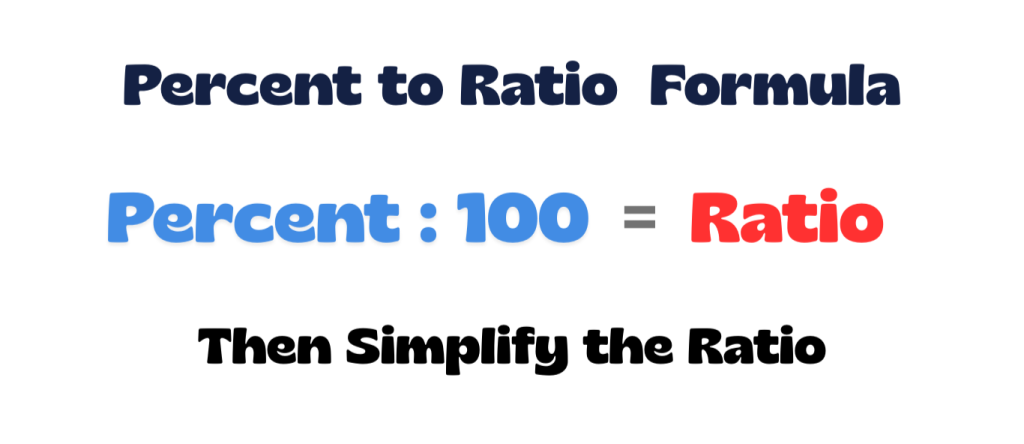
- Make it a fraction and put the number over 100.
- Simplify the fraction by dividing the top and bottom by the same number until it’s in simplest form.
- Write the ratio, change the fraction into a ratio.
Percent to Ratio Formula
Step-by-Step Examples
Example 1: 75%
- Write as a Fraction: 75% is 75/100.
- Simplify: Find the greatest common factor (GCF) of 75 and 100, which is 25. 75÷25=3 divided by 25 equals 3 and 100÷25=4 divided by 25 equals 4/
- Convert to Ratio: Replace the fraction bar with a colon: 3:4.
Example 2: 40%
- Write as a Fraction:
- Simplify: The GCF of 40 and 100 is 20. => 40 ÷ 20 = 2 || 100 ÷ 20 = 5.
- Convert to Ratio: The ratio is 2:5.
Example 3: 95%
- Write as a Fraction: 95% is 95/100
- Simplify: The GCF of 95 and 100 is 5. => 95÷5=19 ||100÷5=20
- Convert to Ratio: The ratio is 19:20.
Example 4: With Decimals (e.g., 12.5%)
- Write as a Fraction: 12.5% is 12.5 / 100
- Remove Decimal: Multiply the numerator and denominator by 10 to get whole numbers: 125 / 1000.
- Simplify: Find the GCF (e.g., 125) => 125÷125=1 || 1000÷125=8
- Convert to Ratio: The ratio is 1:8
Common Mistakes To Avoid
Converting percent to ratio is a very simple calculation and fundamental math skill but when the calculation is done manually mistakes can happen and lead to incorrect results. The most common mistakes that can happen is not being able to simplify the ratio, number being in the wrong order, or confusing the part-to-part and part-to-whole ratios. Another mistake that can happen is calculating in a wrong way percentages with decimal number or ignoring the units of measurement like they needs to be in the same unit like grams, minutes, etc. To avoid these mistakes and other ones use our percent to ratio calculator for accurate result and not doing any math.
When to Use Percent to Ratio Calculator
Use our percent to ratio calculator when you want to convert a percentage into a simple ratio form or to have better understanding what ratio is as a percentage. It is a useful tool for daily life or technical situations where comparing part is more easier than just dealing with only percentages.
The percent to ratio calculator can be used in many area such as cooking recipes or mixes to turn ingredients from percentages to easy to measure ratios, in finance is used to have a more clear budget or investment splits. Also, is used in science to show concentrations and proportions in experiments where ratios are more used than percent. The percent to ratio calculator can be also used in other fields like engineering, construction, surveys, statistics, and more.
Frequently Asked Questions (FAQs)
1. Can a ratio be greater than 100%?
Yes. When a percentage is over 100%, the resulting ratio has the first number larger than the second. For example, 250% becomes 250/100, which simplifies to 5/2 or a 5:2 ratio.
2. What is the difference between a ratio and a percentage?
A percentage shows how much one part represents out of 100 (a part-to-whole relationship). A ratio compares two parts to each other or a part to a total using any numbers (e.g., 2:3).
3. What is the difference between part-to-part and part-to-whole ratios?
A part-to-whole ratio shows a component as part of a total (like 20% = 20 out of 100). A part-to-part ratio compares two separate groups, such as 20 parts of A to 80 parts of B (1:4).
4. How do I convert percentages with many decimal places (e.g., 0.05%) to a ratio?
Treat the percentage as a fraction over 100 (0.05 ÷ 100). Multiply numerator and denominator to remove decimals, then simplify. For example, 0.05% becomes 5/10,000, which simplifies to 1:2,000.
5. How are ratios used in real-life applications like real estate?
Ratios help calculate things like commissions or loan-to-value (LTV) limits. For instance, an 80% LTV means the loan-to-property ratio is 4:5.
6. How can I use ratios for recipe scaling?
If an ingredient makes up 25% of a mixture, the ratio of that ingredient to the rest is 1:3 (1 part ingredient to 3 parts others).
7. How are ratios used in screen aspect ratios?
Aspect ratios are simplified part-to-part ratios. For example, a width that is 177.7% of the height converts to a 16:9 ratio.
8. Why does the calculator use the Greatest Common Factor (GCF)?
The GCF ensures the ratio is in its simplest form. For example, 80% starts as 80:100; dividing both sides by the GCF (20) gives 4:5.

Written byErnie