

Easily convert ratios into percentages with our Ratio to Percent Calculator. Simply enter the parts of your ratio, and the calculator will show you each component’s percentage of the total. Perfect for recipes, school projects, chemistry calculations, or any scenario where you need to understand proportions as percentages. Save time, avoid errors, and instantly see the percentage representation of any ratio.
OR
What Is Ratio?
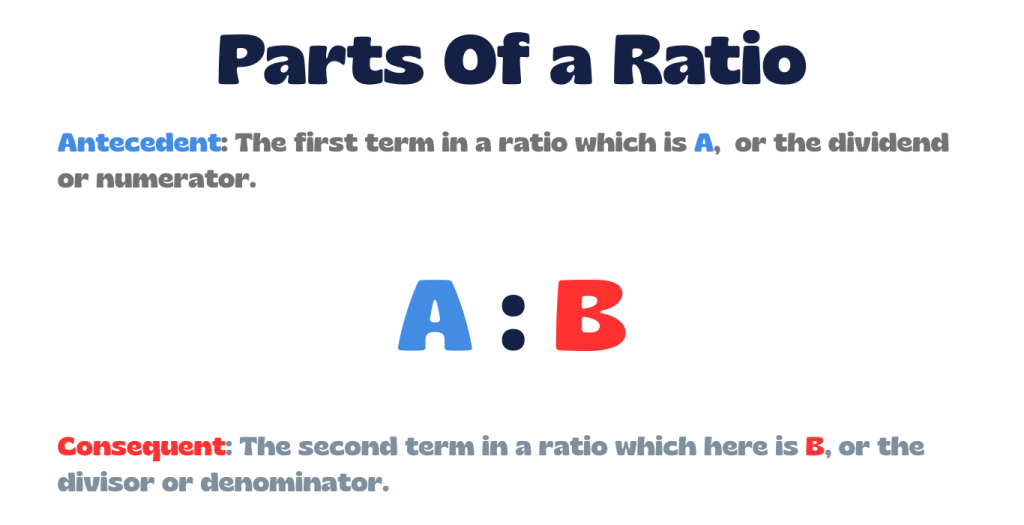
Ratio is a way to compare quantities of two or more, that indicates the proportion of one to another. They usually are written as “a:b” , “a to b” or as fractions a/b. They indicate the relative amount of proportion ratio, like 1 part flour and 4 parts water in cooking recipe, where the numerical order is important and may be reduces like 2:4 to 1:2.
Always keep in mind that ratios display how quantities relate to each other in size or amount. Ratios are separated into 2 main types that are the part-to part in which it is compared one part of a group to another (e.g., 2 carrots to 3 oranges), and the part-to whole in which is compared one part of the total(e.g., 2 tomatoes out of 5 total vegetables).
What Is Ratio to Percent Conversion?
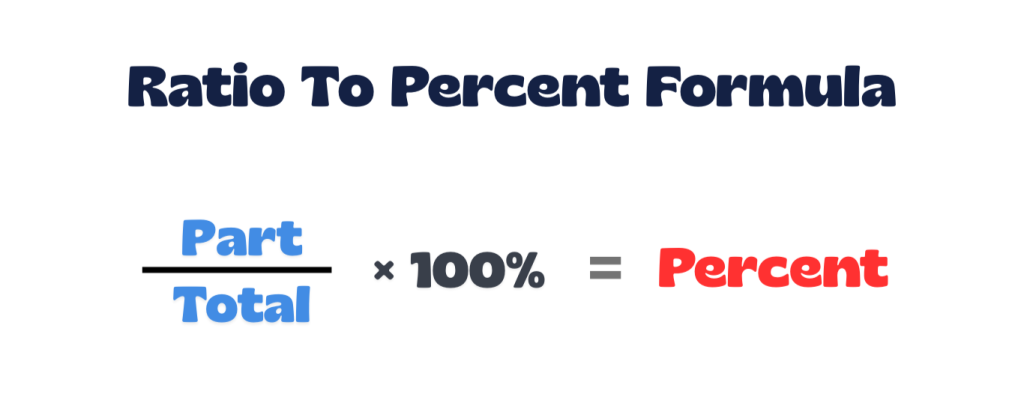
The ratio to percent conversion is know as the process of converting the comparison of two numbers such as a:b to value “out of 100”. These conversion is achieved by turning the ratio into a fraction and then multiply by 100%. It is easy thing to do and makes it easier to understand proportions or parts of a whole. In the below section you will have the step how to convert, formula, examples which are all related to our ratio to percent calculator.
How to Convert Ratio to Percent
To convert ratio to percent is a very simple process and you only need remember the steps how to do it. Firstly we take the ratio turn it into a fraction in which the first number is the numerator and the second one is denominator, then we have to multiply by 100 and in the end just add the percent sing. Below you will have each step explained in details and each of them is how our ratio to percent calculator does it also.
Steps to Convert a Ratio to a Percent
- Write as a Fraction: Put the first number on top and the second number on the bottom, like a:b where ‘a’ is the numerator and ‘b’ is the denominator.
- Divide: Divide the top number by the bottom number.
- Multiply by 100: Take the result and multiply it by 100.
- Add the Percent Sign: Place the ‘%’ symbol next to the result.
Ratio to Percent Formula
Step-by-Step Examples
Example 1: Ratio 3:4
- Write as a fraction: Express 3∶4 as 3/4
- Divide to get a decimal: 3 ÷ 4 = 0.75
- Multiply by 100: 0.75×100=75
- Add the percent symbol: The result is 75%.
Example 2: Ratio 2:5
- Write as a fraction: Express 2∶5 as 2/5
- Divide to get a decimal: 2 ÷ 5 = 0.4
- Multiply by 100: 0.4 × 100 = 40
- Add the percent symbol: The result is 40%.
Common Mistakes To Avoid
Sometimes converting ratio to percent can confusing and everyone can end in making some common mistakes. Below you have list of some of the common mistake than can happen, and to avoid those is to use our ratio to percent calculator.
Here is a simpler, more natural, human-written version that keeps the meaning but is easy to understand:
- Using the second number as the total:In a ratio like 1:4, the total is 5 (1 + 4), not 4. Always divide by the total amount.
- Mixing up the order of numbers:Make sure you calculate the correct part. A ratio of 3:1 gives 75%, but 1:3 gives 25%.
- Using different units: Both numbers must use the same unit (for example, grams and grams) before calculating.
- Forgetting to multiply by 100:A decimal like 0.4 must be changed to 40% by multiplying by 100.
- Rounding too early: Keep full numbers during calculations and round only at the end to avoid errors.
- Not simplifying the ratio first: Simplify big numbers, like changing 20:80 to 1:4, to make calculations easier and more
When to Use a Ratio to Percent Calculator
Use our ratio to percent calculator when you need a better and simpler understanding for parts of a whole in terms of percentage. It turns ratios like 3:2 into easy-to-understand percentages, such as 60% and 40%. When you are cooking some recipe have ratios like 2 cup of flour and 1 cup of salt and some people may find it more understandable to have ingredients proportions in percentages. In finance the ratio to percent calculator can be useful when determining what percentage is spent on specific items like 100$ gas out of 400$ budget. Also, in other fields like education, data analysis or calculating the concentration of different elements the ratio to percent calculator can be very useful.
Frequently Asked Questions (FAQs)
1. What’s the difference between a ratio and a percentage?
A ratio compares one part to another (e.g., 2:3), while a percentage shows one part as a portion of 100 (e.g., 40% of the total).
2. Can a ratio produce a percentage over 100%?
Yes. If the first part is larger than the second, the percentage can exceed 100% (e.g., 4:1 = 400%).
3. How do I find the percentage of a specific part in a ratio?
Divide that part by the sum of all parts, then multiply by 100 to get the percentage.
4. What’s the difference between “part-to-part” and “part-to-whole” ratios?
Part-to-part compares two groups (e.g., 2:3), while part-to-whole compares a part to the total (e.g., 2 out of 5 = 2:5). Calculators usually need part-to-whole ratios to find percentages.
5. Why do percentages of all parts in a ratio add up to 100%?
Because percentages represent portions of the whole. Dividing each part by the total ensures the sum equals 100%.
6. Does the order of numbers in a ratio matter?
Yes. In a 3:1 water-to-syrup ratio, water is 75% and syrup is 25%. Switching the order reverses the percentages.
7. Is there a shortcut for ratios that sum to 10 or 20?
Yes. Multiply each part by 10 if the sum is 10 (e.g., 7:3 → 70% and 30%) or by 5 if the sum is 20.
8. How do I convert a percentage back to a ratio?
Place the percentage over 100 and simplify the fraction. For example, 75% → 75/100 → 3:4.
9. How is this useful in chemistry?
For mass percent composition, divide the element’s mass by the total molecular mass and multiply by 100.
10. How do bakers use ratio to percent calculations?
Ingredients are often expressed relative to flour weight. For example, 3 parts water to 5 parts flour = 60% water based on flour weight.
Explore More Percentage Tools
Explore more percentage calculators to help with different types of percentage problems from our site. Our tools are designed to make it easy to work out with percentage increase, decrease, change, difference, and much more tools that are only related to percentage calculations. Click any calculator below to continue solving percentage questions quickly and accurately.
Decimal to Percent Calculator
Converts a decimal number into a percentage by multiplying it by 100, making values easier to interpret and compare.
Percent to Decimal Calculator
Converts a percentage into its decimal form instantly by dividing by 100, making it easy to use in formulas and calculations.
Fraction to Percent Calculator
Changes any fraction into a percentage by converting the fraction to a decimal and multiplying by 100.
Percent to Fraction Calculator
Turns a percentage into a simplified fraction, helping you express percent values as ratios of whole numbers.
REFERENCE
The percentage calculators on this page is based on standard mathematical definitions and explanations from trusted educational resources: