

Our Markup Calculator is a handy tool that helps businesses, retailers, and service providers quickly determine the selling price of a product by adding a desired percentage to its cost. By entering the cost and the markup percentage, the calculator instantly shows the final selling price, the profit amount, and often the profit margin. It simplifies pricing decisions, saves time, eliminates manual calculation errors, and ensures your prices cover costs while maximizing profitability. Whether you’re setting prices for products, services, or inventory, this tool helps you stay competitive and financially smart.
Note before using the tool:
Below Markup Calculator is the TABLE of what to input and what those inputs give you, see it before using. The tool needs at least 2 inputs so it work propery
| If You Have | Calculator computes |
|---|---|
| Cost Price + Selling Price | Markup % & Profit |
| Cost Price + Markup % | Selling Price & Profit |
| Selling Price + Markup % | Cost Price & Profit |
| Cost Price + Profit | Selling Price & Markup % |
What is Markup?
The amount added to a product or service’s cost to establish its selling price is known as markup. It shows how much a business makes over its costs in order to turn a profit and is typically expressed as a percentage of the cost. A 50% markup on a $30 item adds $15, which makes the selling price 45$, and markup is calculate depending on the original price. Thse type of pricing strategy helps different businesses in staying successful while they are paying for running cost like rent, payroll and utilities. Profit margin, which is determined as a proportion of the selling price rather than the cost, is different from markup and these will be explained in the next sections.
Why Is Markup Important in Pricing
Markup is a crucial method when you are pricing due to the fact that it ensures that a company or business sells their products for a bigger price compared to what they really cost by allowing them to pay their bills and turn a profit. Businesses can simplify price decisions, keep a steady cash flow, and pay for overhead expenses like rent, labor, and supplies by using a constant markup. Markup has a contribution in long-terms growth and success by supporting competitive pricing strategies, being helpful for companies in managing changes in the market, and helping in categorizing items as premium or affordable.
Common Pricing Mistakes Without Proper Markup
Businesses often make mistakes when they are pricing that lower profitability and harm long-term sustainability when they don’t have an effective markup strategy. Some of the most common mistakes that can happen include forgetting to take into consideration for overhead and hidden costs like labor, rent and fees or bills. Also, mistaking profit margin with markup is common errors and can cause an overestimation of the actual profits.
In order to remain competitive or attract more clients, many companies often lower their prices which can result in a lower margin that are harder to correct later. Profits can be more damaged when one single markup to all the products, which affect clients perception of value, and neglecting to adjust the prices when expenses or market conditions changes.
In order to guarantee that prices cover all costs, represent market value, and promote steady cash flow and growth, it is helpful to use a systematic, frequently evaluated markup. So to have better calculation of markup and error free use our Mark up Calculator.
Markup Vs Margin
Both markup and margin describe profit but they differ in their perspective. As we have said before that margin is crucial method for pricing because of the fact that it is the amount added to the product costs to determine the selling price. Also, it is calculated as e percentage of the cost. On the other hand, margin or also known as profit margin, is a method that is used for evaluating the overall profits and financial health that shows profit as a proportion of the selling price.
You have to keep in mind that markup percentages are always higher than margin percentages for the same product or service due to the fact that markup is based on cost and margin on revenue. In real life, companies apply margin to evaluate performance and profitability and markup to determine pricing.
What Is a Markup Calculator?
Our markup calculator is a tool designed to calculate pricing that will helps different companies to evaluate items selling price by applying a markup percentage to its cost. By entering the cost, markup, selling price and cost our mark up calculator will provide you the final price, markup amount, profits and costs prices. To know how to combine the input to get what results you want se the section below the calculator. These tool is created to save you time, lower mistakes when calculating manually, so businesses are helped in setting accurate, competitive and profitable prices.
How Markup Is Calculated
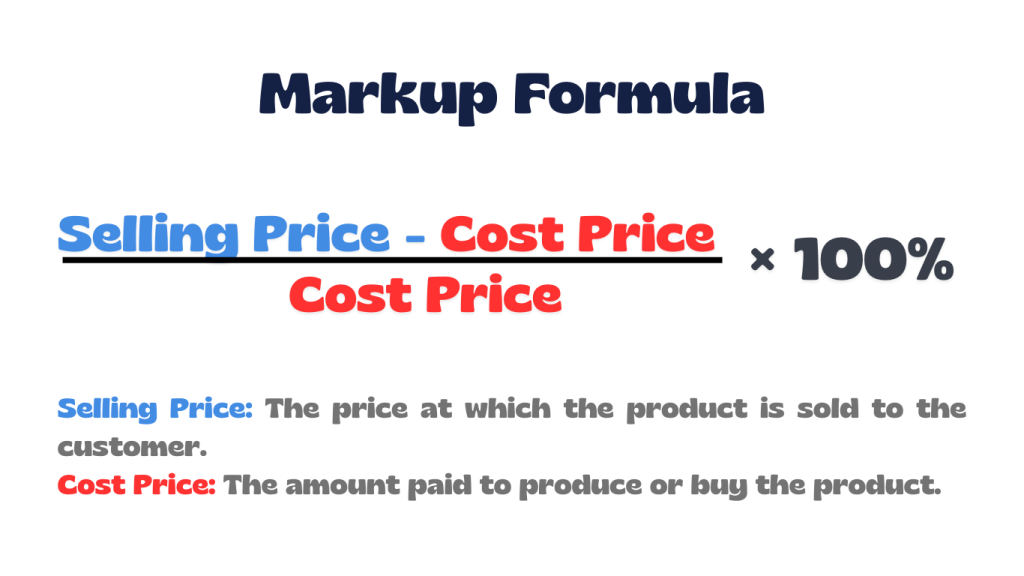
Markup to be calculated need to divide the profit by the original cost and then multiply by 100 to express the results as a percentage. Selling price minus cost is hoe the profit is calculated. These method indicates the amount of profit made in relation to the cost, unlike the profit margin which depends on the selling price. Using this method helps companies to price their items accurately and may ensure profitability for them.
Markup Formula
How to Calculate Markup Manually
Here you will have an real life markup calculation done manually so you can have a better ideas how its done and how it works. These also is how our markup calculator does the calculation for you.
Step 1: Identify the Cost Price
- Suppose you buy a coffee maker for $50.
Step 2: Decide the Markup Percentage
- You want a 40% markup to cover expenses and profit.
Step 3: Calculate the Markup Amount
Markup Amount = Cost Price} x Markup % ÷ 100)
50×(40÷100)=50×0.4=20
Step 4: Determine the Selling Price
Selling Price= Cost Price + Markup Amount
50+20=70
Result
- Cost Price: $50
- Markup Amount: $20
- Selling Price: $70
- Markup Percentage: 40%
Why Use a Markup Calculator?
A markup calculator is an helpful tool that helps to quickly determine the selling price, ensuring the profitability and accurate pricing. It saves time, lowers the possibility for mistakes, and it primary job to translate markup into profit for more cleaner understanding of earnings. Below you will have some of the key benefit.
Key Benefits:
- Instant Pricing: Quickly calculates selling price from cost and markup.
- Ensures Profitability: Covers expenses and generates profit.
- Strategic Pricing: Adjust prices to remain competitive while maintaining margins.
- Reduces Errors: Eliminates manual math mistakes.
- Understand Profit Margin: Converts markup to profit margin for better financial insight.
- Supports Market Research: Helps analyze competitor pricing and potential markups.
- Simplifies Complex Scenarios: Can factor in discounts, taxes, or VAT for optimal pricing.
Common Uses of Markup Calculators
E-commerce, services, retail companies often apply markup or use markup calculator to determine successful rates based on cost. They are helpful in figuring out selling prices, calculating the markup percentage, figuring out costs by working backwards, and evaluating profit margins. These tool is crucial for managing profits and making wise price decisions. Markup calculator is also used in doing the strategy and planning for discounts which also helps in managing inventory and cleaning it. There a lot of reason to use our tool so feel free to use it based on your needs.
Markup Examples in Real Life
Ordinary products can change differently depending in pricing structures since the markup levels can vary greatly based on industry, operating expenses, demand, and customers perception of the value. In fields like food, retail, consumer products markup is commonly high due to overhead costs that might be rent, marketing or labor. Coffee, wine, clothes, popcorn at movies theaters, are often marked up by 100% to more than 1000%. While major products like smartphones still have huge markup despite increased production costs.
In everyday retail markups have a range that starts from a low margins on groceries that can be 5% – 25%, and the opposite in cosmetics, clothing, special products where the margin is very high. These real-world examples illustrate the importance of markup in pricing choices and the need to separate it from profit margin, which expresses profit as a percentage of the selling price.
Common Mistakes When Calculating Markup
One of the most common mistakes that happens when calculating markup is to confuse it with profit margin, which why in the previous sections we have written how they differ. If you confuse and not knowing their differences can lead to overestimating the profits, cause a high margin requires a much greater markup than many expect. Another common mistake is to forgetting to include all the costs when calculating markup. Business often don’t include the costs like rent, labors, shipping , feed or return but they only include direct costs.
You have to keep in mind that markup should always be calculated using the complete cost base, which includes , which includes both the direct and indirect charges, in order to prevent these mistakes. To make sure prices are both profitable and competitive, they should be compared to market situations and rival prices.
Frequently Asked Questions (FAQs)
1. Should I include overhead costs in my markup calculation?
Yes. When calculating markup, include all costs—both direct costs (materials, labor) and indirect costs (rent, utilities, salaries)—to ensure your selling price covers expenses and generates profit.
2. What does a 25% markup look like?
If a product costs $10 and you apply a 25% markup, the selling price becomes $12.50. The markup amount is $2.50 ($10 × 0.25).
3. Can markup percentages be higher than 100%?
Absolutely. Since markup is based on cost, there’s no upper limit. For example, if a software license costs $1 to distribute and you sell it for $100, the markup is 9,900%. Profit margin, however, can never exceed 100%.
4. Should I calculate markup before or after VAT/Sales Tax?
Markup should be calculated on the net cost (excluding tax). Apply VAT or sales tax afterward to determine the final price the customer pays.
5. What happens if I set my markup too low?
A low markup might not cover overhead costs like rent, utilities, or staff salaries, potentially causing losses even if each sale seems profitable.
6. What is the difference between markup and gross profit?
Markup is the percentage used to set the selling price based on cost, while gross profit is the actual dollar amount left after subtracting the cost of goods sold from revenue.
7. Can I use the same markup for both products and services?
You can, but service markups often need to be higher to account for unbillable hours, specialized tools, and labor overhead not present in physical products.
8. Can I use markup for professional services?
Yes. For services, “cost” includes labor hours and specialized tools. Apply a markup (often 50% or more) to cover unbillable time, overhead, and ensure profitability.
9. Why is my markup percentage higher than my profit margin?
Markup is based on the cost (a smaller number), while margin is based on the selling price (a larger number). For instance, if you buy something for $50 and sell for $100, markup is 100% but margin is only 50%.
10. How do I find the markup if I only know the profit margin?
Use this formula:
Markup % = (Margin % / (100−Margin %)) × 100
For example, to achieve a 20% margin, apply a 25% markup.
Explore More Percentage Tools
Explore more percentage calculators to help with different types of percentage problems from our site. Our tools are designed to make it easy to work out with percentage increase, decrease, change, difference, and much more tools that are only related to percentage calculations. Click any calculator below to continue solving percentage questions quickly and accurately.
Percentage Increase Calculator
Measures how much a value has gone up from its original amount, expressed as a percent.
Percentage Difference Calculator
Calculates the percent difference between two numbers by comparing how far they are from each other.
Percentage Change Calculator
Finds how much a value has increased or decreased from its original value in percentage terms.
REFERENCE
The Markup calculator on this page is based on standard mathematical definitions and explanations from trusted educational resources: