
Our Average Percentage Calculator helps you quickly find the overall percentage from multiple values or scores without doing manual math. Instead of calculating each percentage separately and risking errors, this tool combines all values into a single, accurate average percentage in seconds. It’s especially useful for students, teachers, businesses, and analysts who work with multiple results, grades, or performance metrics. This calculator saves time, improves accuracy, and ensures consistent calculations across different datasets, making it ideal for both academic and real-world use.
What Is an Average Percentage?
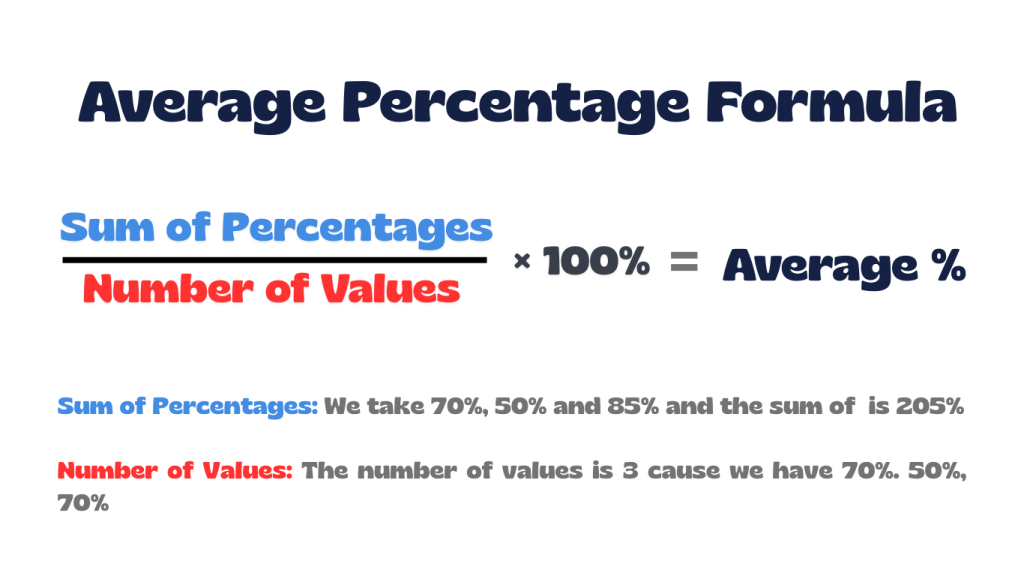
The average percentage is determined by the mean value and several percentages. In situations when percentages use the same total or sampling size, the average is calculate simply by adding them up and divide the result by the total number of values. Test scores and other comparable equal weights results are often averaged by these method.
On the other hand, when percentages are given from multiple totals or sample sizes, they must be used as weighted averages. In these situations, the real value of each percentage is first determined, added together, divided by the total and then in the end multiplied by 100. This ensures that the final average correctly represents the actual proportions.
Keep in mind , use a simple average for equal groups and a weighted average when totals differ to avoid misleading results.
How an Average Percentage Is Calculated
Depending on the data that you have, there are two methods for calculating an average percentage. The first method is when you have groups of equal size that is a simple average calculation, for these method you need to sum all the percentages and divide by the total number of values. The second method is the same thing as we described before when used weighted averages for groups of varying sizes. To calculate the final percentage we need to convert each percentage to a decimal number, multiply it by its initial values, add all of the results, divide by the total and then multiply by 100. In the next sections you will have real examples of for the two method which can be done also with our percentage average calculator .
Difference Between Average Percentage and Simple Average
A simple average determines the central value of any set of numbers while considering each value equally, and as we have explained before is done by adding them and dividing by the total value. The similar approach is applied with an average percentage, which is only suitable for percentage values (out of 100). The main difference of them is that averaging percentages is only suitable when the number originate from groups of identical size, if the underlying group sizes are different, a weighted average must be performed in order to achieve an accurate and significant overall percentage.
Average Percentage Formula
Step-by-Step Example Calculation
Below you will real scenarios on how to calculate average percentage. Both the methods are accurate and show how the average percentage calculator also work especially the first method that is the only calculation that our calculator does. These method use used widely and provide a better understanding on how to average percentages.
Method 1: Simple Average (Equal-Sized Groups)
Use this method when all percentages come from the same total value, such as exam subjects with the same maximum marks.
Example (Student Test Scores): A student scores 80% in Math, 90% in Science, and 70% in English. Each subject is out of 100 marks.
Steps:
- Add the percentages: 80 + 90 + 70 = 240
- Count the subjects: 3
- Divide: 240 ÷ 3 = 80%
Average Percentage = 80%
Method 2: Weighted Average (Different-Sized Groups)
Use this method when percentages are based on different totals, such as sales from regions with different volumes or tests with different maximum marks.
Example (Sales Performance):
- Region A: 25% defects out of 200 products
- Region B: 20% defects out of 100 products
Steps:
- Convert percentages to actual values:
- Region A: 25% of 200 = 50
- Region B: 20% of 100 = 20
- Add actual values: 50 + 20 = 70
- Add total products: 200 + 100 = 300
- Divide and convert to percentage: (70 ÷ 300) × 100 = 23.33%
Weighted Average Percentage = 23.33%
Tip:
Use a simple average only when all groups are equal in size. When totals differ, a weighted average gives the correct and fair result.
Common Mistakes to Avoid When Calculating Average Percentage
When you are calculating average percentage mistakes can often occur when you are treating unequal groups sizes as equal one, which they give us wrong results if they are not treated or used as weighted averages. Another common erros than can happen is to use the incorrect base values when calculating increase or decrease, or confusing percentage points with percentage change.
Sometime we can mistakenly add or subtract them for subsequent changes instead of doing a step by step process. Results can be more impacted by simple calculation errors, such as failing to convert percentages into decimals or placing decimals incorrectly. To ensure accurate averages, always take sample sizes, context, and appropriate methods into account.
When to Use an Average Percentage Calculator
Use our percentage average calculator when you need to calculate the mean of multiple percentage values that are based on the same scale. These tool calculates a simple average, which means that all the percentages are treated equally. Below you will have a list of uses cases that our average percentage calculator can preform accurately.
Use Cases of Average Percentage Calculator
- Equal-Weight Test Scores : Use it to average percentages from subjects or tests that all carry the same importance
- Performance Comparisons: Helpful for finding the average success rate, accuracy rate, or completion rate when each percentage represents the same type of measurement.
- Multiple Inputs, Same Base: The calculator allows users to add or remove rows, making it easy to average many percentages quickly, as long as they are comparable.
- Quick Academic or Statistical Insights: Ideal for students, teachers, and analysts who want a fast overview without complex weighting or conversions.
How the Calculator Works
Our average percentage calculator is designed to be user-friendly tool that can be used by anyone. You only need to enter two or more percentages values based on your calculation, and you can add as many rows as you need to have your accurate and desired results. Below you have a list of what or average percentage calculator does for you:
- Adds all entered percentages
- Divides the total by the number of values
- Displays the result as the average percentage, rounded to two decimals
Benefits of Using an Average Percentage Calculator
Our average calculator is created to save you time and give accurate results by quickly calculating results that would need manual calculation that lead to errors. It makes it simpler to compare outcomes across several datasets and lowers the possibility of mistakes, particularly when working with numerous percentages or weighted data. The average percentage calculator helps you to do better decisions making in business, finance, academics, and daily life by displaying results in an understandable percentage format. It is a useful tool for quick evaluation and understandable data interpretation because of its simplicity and flexibility.
Explore More Percentage Tools
Explore more percentage calculators to help with different types of percentage problems from our site. Our tools are designed to make it easy to work out with percentage increase, decrease, change, difference, and much more tools that are only related to percentage calculations. Click any calculator below to continue solving percentage questions quickly and accurately.
Percentage Increase Calculator
Measures how much a value has gone up from its original amount, expressed as a percent.
Percentage Difference Calculator
Calculates the percent difference between two numbers by comparing how far they are from each other.
Percentage Change Calculator
Finds how much a value has increased or decreased from its original value in percentage terms.
REFERENCE
The Average Percentage Calculator on this page is based on standard mathematical definitions and explanations from trusted educational resources: