
Our Grade Percentage Calculator helps students and educators quickly convert marks or scores into a percentage. By entering the points earned and the total possible points, this tool instantly calculates your grade percentage, making it easier to understand academic performance. It is useful for exams, quizzes, assignments, and final grades, helping users track progress, compare results, and plan for future assessments with accuracy and confidence.
What Is a Grade Percentage?
A grade percentage is a numerical representation of school performance that is computed by multiplying by 100 and dividing the points obtained by the total number of potential points. These type of measuring method for academic achievement gives a simpler way to compare the performance among assignments, tests, and course by providing the exact score on a scale from 0 to 100.
In order to determine the GPA of each student, evaluate academic standing, and analyze student development in more details than just letter grades alone. Grade percentages are commonly converter into letter grades like A, B, or C, and below you will have an image for each percentages and their corresponding letter grade. Due to this accuracy, even small differences in percentages can have a big impact on final grades, ranks, or qualifying results.
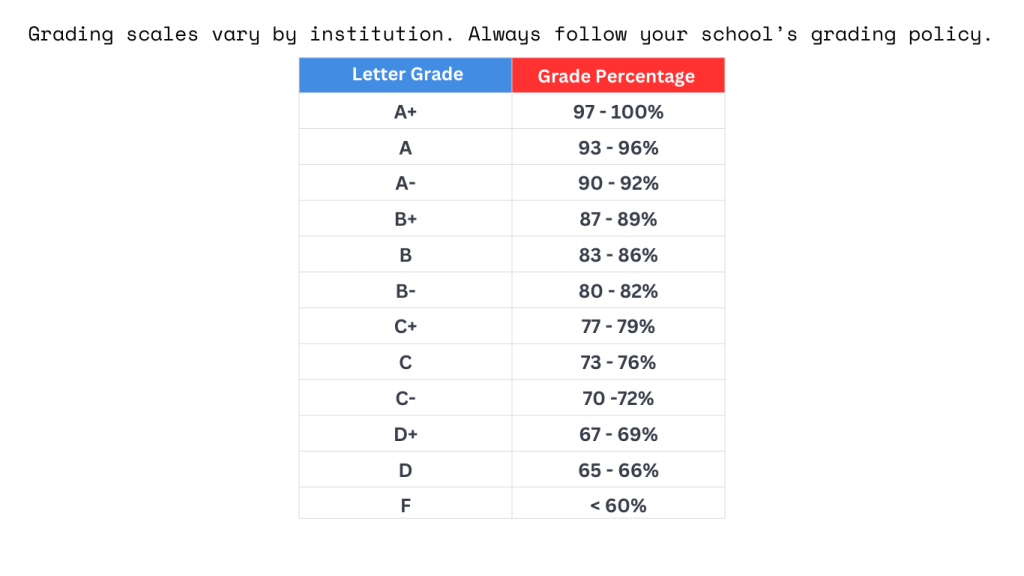
Why Grade Percentages Are Used in Education
Grade percentages are commonly used in education due to the fact that they offer an accurate and consistent method of evaluating students overall performance. Percentages provide more precise information than letter grades, which makes it simpler to identify performance levels and monitor development over time. They help in the calculation of GPA and rankings, provide consistent comparisons between classes and universities, and are crucial in the admissions and scholarship selection processes. Despite the fact that they are very useful, percentages should be evaluated carefully because they may not precisely reflect true mastery due to factors such tests difficulty and weighting.
Grade Percentage vs Marks and Scores
The raw points a student receives on a test or assignment are represented as marks, such as 18 out of 20. These points or marks gained can be represented as percentage of the total marks, in which grade percentages turns them into a common format that helps in the comparison of the performance across different subjects or exams. Grades such as A, B, or C organize percentages ranges into a more general method of categorizing which shows an overall performance. Grades offer a brief overview that highlights overall performance and minimizes the impact of minor score variations, whereas marks and percentages offer accurate and in-depth measurements. In the process of academic evaluation, each of the approaches gives a balance in accuracy, comparison and clarity in distinct way.
What Is a Grade Percentage Calculator?
Our grade percentage calculator is a tool that is used to calculate academic performance by taking the points earned and dividing them with the all possible points and then converting the results into a percentage. The grade percentage calculator helps teachers and students to accurately and quickly calculating quiz, tests, or final course grade percentage. They are helpful for tracking development, creating study objectives, and reviewing general academic achievement. These tool saves time and minimized calculation mistakes, particularly when handling complicated grading schemes or many topics. These type of grade percentage calculator can be commonly used in schools, colleges, universities to make sure for consistent and transparent grades.
Why Grade Percentages Matter
Grade percentages are and play a crucial part in shaping a students academic life and their future related to their profession. They have a direct impact on GPA, which establishes academic status, university admissions, honors eligibility, and scholarship eligibility. As we mentioned before that percentages provide a better and precise evaluation of the performance, they also offer a cleaner picture of the students achievement on the course materials rather than just letter grades.
When student may have better and higher percentages for them is good because it gives opportunities for advanced education, competitive programs, and early career opportunities. These makes them as grading method to be more essential for evaluating their potential and performance, so to have accurate calculation use our grade percentage calculator.
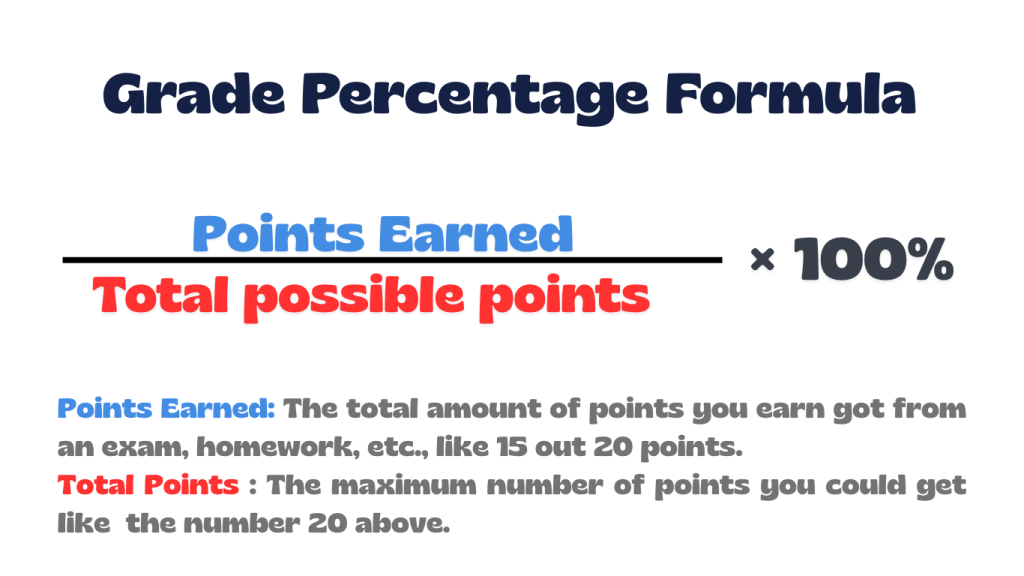
Grade Percentage Formula
How to Calculate Grade Percentage
To calculate the grade percentage calculator we need to apply the formula that is in the image above. The method that we will do next can be applied for single assignments, exams, or to calculate the overall grades for multiple subjects. These manual calculation and method is also applied in our grade percentage calculator.
- Step 1: Identify Points Earned and Total Points
- Step 2: Divide the points earned by the total points possible to find the decimal equivalent of the grade.
- Step 3: Convert to Percentage, multiply the resulting decimal by 100.
Step-by-Step Example:
- Step 1: A student scores 45 out of 50 points on a test.
- Step 2: Divide 45 by 50 → 0.9
- Step 3: Multiply by 100 → 90%
Benefits of Using a Grade Percentage Calculator
As you have read before that one of the main benefits of the grade percentage calculator is to help students and teachers to track the performance of the academic year with efficiency and accurately. These tool reduces stress, provides transparency, and allows you to make future plans for your grading scores. It saves time by automating complex calculations like weighted averages or cumulative grades. Based on the core benefits that grade percentage calculator gives feel free to use whenever you need it.
Common Mistakes When Calculating Grade Percentage
When you are calculating grade percentages mistakes can occur and some of the reason can be ignoring assignments weights, improper way of handling decimals, rounding to early. Below you will have a list of some common mistakes that can happen and the reason why.
- Ignoring Assignment Weights: Not considering that homework, quizzes, and exams may have different weightings.
- Mismanaging Percentages and Decimals: Using incorrect decimal conversions (e.g., 0.5 instead of 0.05 for 5%) or forgetting to multiply by 100.
- Rounding Too Early: Rounding intermediate results can lead to inaccurate final percentages.
- Using Raw Averages: Averaging percentages without applying the correct weighted formula.
- Misplacing Decimal Points: Simple division or multiplication errors that significantly affect the result.
- Incorrectly Calculating Percent Error: Using the wrong base or ignoring absolute values when computing errors.
Frequently Asked Questions (FAQs)
1. How do I calculate my grade if the categories don’t add up to 100%?
If your syllabus categories don’t total exactly 100%, you need to normalize them. Add all category weights together, then divide each category by that total to find its true impact on your final grade.
2. How can I calculate my current grade if some assignments aren’t graded yet?
You can calculate your current grade using only the assignments you’ve completed so far. The calculator adjusts the total weight automatically and shows your average based on graded work only.
3. How do I convert my grade percentage to a 4.0 GPA?
GPA scales vary by institution, but a common conversion looks like this:
- 90–100% → 4.0 (A)
- 80–89% → 3.0 (B)
- 70–79% → 2.0 (C)
- 60–69% → 1.0 (D)
4. How do I calculate a grade when assignments have different point values?
Use the total points method. Add up all the points you earned and divide by the total possible points. For example, if you score 15/20 and 45/50, your percentage is (15 + 45) ÷ 70 = 85.7%.
5. What does “Pass/Fail” usually mean in college?
While 60% is often considered a passing grade, many college programs require at least a 65% or higher to meet course or major requirements. Grades below this threshold may be recorded as a fail.
6. Can my grade percentage be higher than 100%?
Yes. If your instructor offers extra credit, those points are added to your earned total without increasing the maximum possible points, which can push your percentage above 100%.
7. Does getting a zero on one assignment mean I fail the course?
Not necessarily. The impact depends on the assignment’s weight. A zero on a small homework task may have little effect, but a zero on a major exam or project can severely limit your final grade.
8. How does rounding affect my final grade?
Many schools round final percentages to the nearest whole number, so an 89.5% may round up to 90%. However, some instructors do not round at all, so it’s important to check your syllabus.
9. Why did my percentage drop after scoring 90% on a test?
If your average was already higher than 90%, adding a lower score can bring the overall average down. This is normal and happens when new scores are below your current average.
10. Are UK university grade percentages different from US ones?
Yes. In the UK, a 70% is often considered a top-grade “First-Class” result, while in the US a 70% is usually closer to a “C.” Grading standards vary widely by country.
Explore More Percentage Tools
Explore more percentage calculators to help with different types of percentage problems from our site/ like the Grade Percentage Calculator. Our tools are designed to make it easy to work out with percentage increase, decrease, change, difference, and much more tools that are only related to percentage calculations. Click any calculator below to continue solving percentage questions quickly and accurately.
Marks Percentage Calculator
Helps you quickly convert marks obtained into a percentage by dividing the score by the total marks and multiplying by 100.
Decimal to Percent Calculator
Converts a decimal number into a percentage by multiplying it by 100, making values easier to interpret and compare.
Fraction to Percent Calculator
Changes any fraction into a percentage by converting the fraction to a decimal and multiplying by 100.
REFERENCE
The Grade Calculator on this page is based on standard mathematical definitions and explanations from trusted educational resources: