
Our Marks Percentage Calculator helps students quickly find their percentage score based on the marks obtained and the total marks. Instead of doing manual calculations, this tool instantly converts scores into percentages, making it easier to evaluate academic performance, understand results, and compare scores across subjects or exams. It is commonly used by students, teachers, and parents for exams, tests, and overall grade assessment.
What Are Marks ?
In education, a student receives marks, which are numerical scores or points, for particular tasks like assignments, exams, or assignments. Marks simply indicate the level of performance or achievement in different subjects and they provide a feedback on what you are strong and weak. A simple example can be on a math test you earned 75 out 80 points, which can be also represented as a percentage that is equal to 93.75%. In simple words, marks are what you earn on like your homework and they contribute to you final term grade.
Raw Marks vs Normalized Marks
Raw marks are the initial results a student receives immediately from an exam, while normalized marks are modified scores intended to assure fairness when tests are held in multiple sessions with different levels of difficulty. Normalization places all candidates on a same scale using statistical techniques including averages, standard deviations, and percentiles. This is often used in big competitive exams with numerous shifts to prevent students from improperly benefiting from an easy test or being disadvantaged by a harder one.
How Marks, Grades, and GPA Are Connected
Marks as we described before are numerical score that each students gets when they are evaluated for their performance in individual exams or assignments. They are commonly shown as percentage or points like 85% or 85 out of 100.
Grades are a classification method for marks that interprets them by classifying them according to descriptive levels like Excellent or Good or letter grades (A, B, and C). When marks are converted into grades like 90 -100% becomes a letter grade A, and these is used as simpler method to evaluate into more broader categories.
Grade Point Average (GPA) takes it a step further by gathering or combining all courses grades and gives a single weighted average grade. GPA is typically shown on 4.0 scale which demonstrated the overall academic achievement in a variety of subjects, and for university admissions or scholarships.
Keep In Mind:
Marks measure, grades categorize, and GPA summarizes academic results.
What Is a Mark Percentage Calculator?
Marks percentage calculator is a simple tool that helps you convert gained marks into a percentage, by taking the total marks scored and then divide it by the total marks of the text and multiply by 100. These tools can be used by students to accurately calculate their academic performance for both single test or homework and for multiple subjects. This tool helps to track progress in different subjects, achieving you goals, reaching test requirements or scholarships without the need for manual calculation errors/. Marks percentage calculator offers a consistent result that makes it simple to compare among subjects, terms, and grading schemes.
When to Use This Calculator
The marks percentage calculator can be used by anyone and for every subject as long as marks are known. Below you have a list why these is a useful tool and when it commonly used:
- Exam and test result checking
- Homework and assignment evaluation
- Academic self-assessment
- Preparing results for applications or reports
How to Use the Marks Percentage Calculator
Follow these simple steps to calculate your marks percentage:
- Enter the marks you scored in the Scored Marks field
- Enter the maximum possible marks in the Total Marks field
- Click the “Calculate Marks %” button
- The calculator will instantly display your marks percentage, rounded to two decimal places
How Marks Percentage Is Calculated
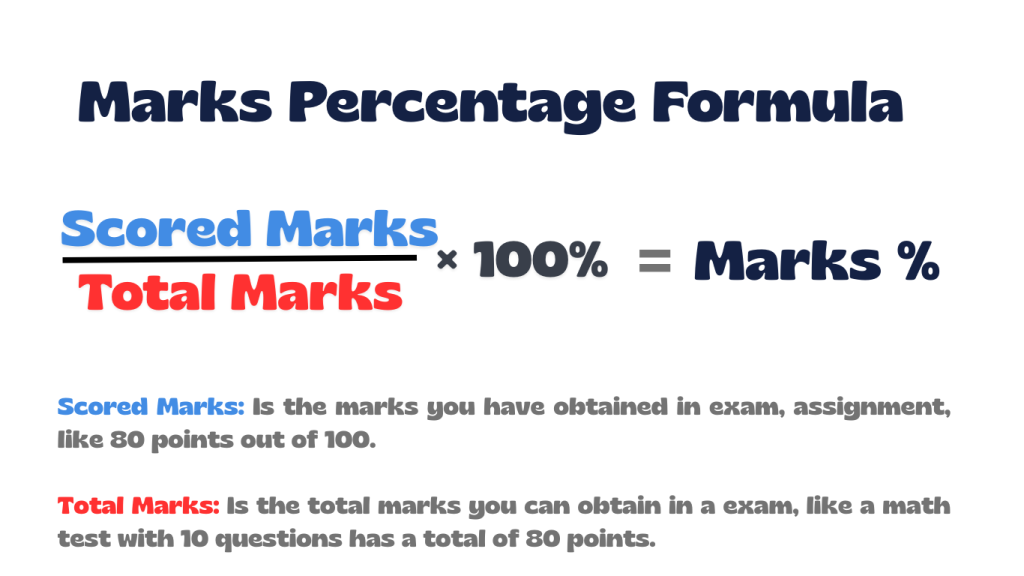
If you need to calculate marks percentage you need to divide the marks you have obtained by the total possible marks and the result that is outputted needs to be multiplied by 100. These method is effective for both single test and several subjects. In situations when subjects have different importance so their marks are given extra importance in the calculation. In the below sections you will find an illustration of the formula and an example of the calculation process, which is how marks percentage calculator works.
Marks Percentage Formula
Example Calculation of Marks percentage
In these section you we will understand how to calculate percentage of marks and perform a manual calculation of marks percentage for a single subject and multiple subject together. Both of these scenarios can be applied in our calculator.
Example for Single subject:
A student in math test has scored 68 marks out of 80 total marks possible.
- Step 1 : Divide => 68 / 80 = 0.85
- Step 2: Multiply => 0.85 X 100 = 85
Result: 85 %
Example for Multiple subjects:
A student in math has scored 85 out 100, biology 75 out of 100 and history 95 out of 100.
- Step 1: Sum Marks Obtained: 95 + 85 + 75 = 255.
- Step 2: Sum Total Marks: 100 + 100 + 100 = 300.
- Step 3: Calculate Percentage: (255 / 300) × 100 = 85%.
Why an Online Calculator Is Better Than Manual Calculation
Mark percentage calculator compared to manual calculation provide a quicker, accurate and more reliable way in determining academic results. It uses standard formula to be accurate every time, removing common human mistakes, and give directly the results. Manual calculation is tends to be more prone to mistakes and consumes you time, especially in cases when you are dealing with decimal number or to many subjects. On the other hand, the mark to percentage calculator does the calculation more accurately and effortlessly. These is a practical and stress free tool for both students and teachers since they handle more advanced scenarios including performance tracking, weighted subjects and GPA to percentage conversion.
Common Mistakes to Avoid
Calculating marks percentage often seems a simple thing to do but mistakes can happen due to incorrect totals, manual calculation errors, or misinterpretation of grading guidelines. Some of the most common mistakes may be rounding numbers to soon, dividing by the incorrect total marks, not considering topic weights, and mistaking decimal for percentages. Inaccurate results may arise from problems with data entry, such as missing some marks, misreading scores, or entering numbers improperly.
Common Marks Percentage Interpretations
In order to evaluate academic performance, marks percentage grading transforms numerical score ranges from 0 to 100% into standardized grades or categories. Many institutions use comparable percentage ranges to categorize student achievement, even when grading schemes differ among schools, boards, and nations. Below is a general overview of how marks percentages are commonly interpreted in academic context:
- 90–100% (A+ / A) – Outstanding or exceptional performance
- 80–89% (A / A-) – Excellent performance with strong understanding
- 70–79% (B+ / B) – Very good or above-average performance
- 60–69% (C+ / C) – Good or satisfactory performance
- 50–59% (D+ / D) – Pass or marginal performance
- 40–49% (E / D-) – Borderline or conditional fail (varies by institution)
- Below 40% (F) – Fail
Frequently Asked Questions (FAQs)
1. How do I calculate my percentage for multiple subjects?
To calculate your overall percentage, add up the marks you scored in all subjects and divide them by the total maximum marks. Then multiply the result by 100. Our Marks Percentage Calculator does this instantly and accurately for you.
2. How can I find my marks if I only know the percentage?
If you know your percentage and total marks, multiply the percentage by the total marks and divide by 100.
Formula: (Percentage ÷ 100) × Total Marks = Marks Obtained.
3. Can my marks percentage be more than 100%?
Yes, a percentage can exceed 100% if bonus marks, extra credit, or grace marks are included and your total score goes beyond the original maximum marks.
4. How do I calculate percentage when subjects have different total marks?
Add all the marks you obtained and divide them by the sum of all maximum marks. For example, scoring 80/100, 70/80, and 45/50 gives a total of 195/230, which equals about 84.78%. In our Marks Percentage Calculator use the total that are 195 to scored marks and 230 for total marks.
5. Why is marks percentage important?
Marks percentages provide a standardized way to measure and compare academic performance. They are widely used for exams, college admissions, scholarships, and eligibility criteria. So to have accurate results use Marks Percentage Calculator
6. What if my mark sheet shows only grades instead of numbers?
If numerical marks aren’t provided, you’ll need to convert grades using your institution’s grading system or GPA scale. Many boards assign a percentage range to each grade, or you can use our Grade Calculator for quick conversion.
7. Should I round my percentage up or down?
Most academic systems follow standard rounding rules:
8. What is the “Best of Five” rule in percentage calculation?
Some education boards calculate percentages using only the top five scoring subjects. If you have six subjects, the lowest score may be excluded—though certain subjects like English are often mandatory.
Explore More Percentage Tools
Explore more percentage calculators to help with different types of percentage problems from our site. Our tools are designed to make it easy to work out with percentage increase, decrease, change, difference, and much more tools that are only related to percentage calculations. Click any calculator below to continue solving percentage questions quickly and accurately.
Percentage Increase Calculator
Measures how much a value has gone up from its original amount, expressed as a percent.
Percentage Difference Calculator
Calculates the percent difference between two numbers by comparing how far they are from each other.
Percentage Change Calculator
Finds how much a value has increased or decreased from its original value in percentage terms.
REFERENCE
The Mark Percentage Calculator on this page is based on standard mathematical definitions and explanations from trusted educational resources: