
The Percent to Decimal Calculator helps you quickly convert any percentage into its decimal form with accuracy. Whether you’re working on math homework, financial calculations, science formulas, or everyday percentage problems, this tool eliminates manual errors by instantly dividing the percentage by 100. Simply enter a percent value and get the exact decimal result in seconds, making percentage conversions fast, reliable, and stress-free.
What Is Percent to Decimal Conversion?
To convert percent to decimal is a simple process that is achieved by converting a percentage into its equal decimal number. These method is done by dividing the percentage by 100, which is the same thing as moving the decimal point two places on the left, and then removing the percentage sing. Removing the percentage sing is a crucial step when making the conversion especially when finding proportions or discounts. To have a better understanding for the steps to convert, why it’s used a percent to decimal calculator and examples see the following sections.
How to Convert Percent to Decimal
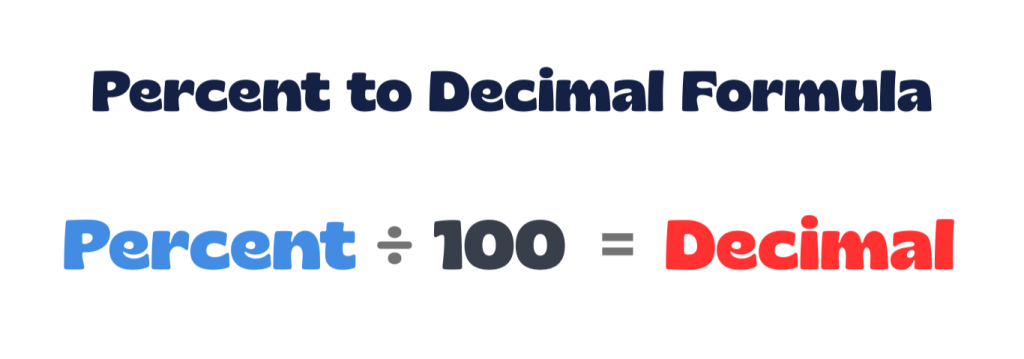
Here we will take explain the process of converting the percentage to decimal number. Firstly, we identify the number like 75% and we take only the numerical part. Then we divide by 100 or move the decimal point two places on the left of the number which give the 0.75 decimal number. As you saw the percent sing was removed from the original percentage number. Below you will have also an illustration image of the percent to decimal formula.
Percent to Decimal Formula
Step-by-Step Examples
Example 1: Whole Number Percentages -> 45%
- Remove the % sing -> 45
- Move the decimal point 2 places on the left -> Result: 0.45
Example 2 : Percentages with Decimals -> 7.5%
- Remove the % sing -> 7.5
- Move the decimal point 2 places on the left -> Result: 0.075
Example 3: Percentages Over 100 -> 128%
- Remove the % sing -> 128
- Move the decimal point 2 places on the left -> Result: 1.28
Example 4 : Using division -> 70%
- Remove the % sing -> 70
- Divide by 100 -> Result: 70 / 100 = 0.7
Common Mistakes to Avoid
In the conversion process from percent to decimal beside being an easy thing and fundamental math skills making mistakes is also that easy, and especially when there are small percentages or percentages that are over 100%. One of the most common one is to move the decimal point to the right (which is done when converting from decimal to percent) rather than to left how it should be.
The rule is to move decimal point 2 places on the left but sometimes people only move 1 place like converting 50% to 5.0 when it should be 0.50. Sometimes when the percentages itself are decimal ones people usually forget to add right number of zero like having 4.5% to 0.45 instead of 0.045. One of the reasons we have created the percent to decimal calculator is to avoid these mistakes and other ones can happen.
When to Use Our Percent to Decimal Calculator
Use our percent to decimal calculator when you are converting a percentage into their decimal number, and especially for daily life tasks such as sales tax, discounts, interest, analyzing scores. For academic purposes it can be used in subjects like probability, statistics and fiancé when the decimal number are required for precise calculations and different formulas.
Some common situations that our percent to decimal calculator can be when shopping and you want to figure out the discount amount, in finance for interest rates or loan payments, for fast calculation when you leave tip in restaurant and much more situations. Percent to decimal calculator needs only to input the values, click calculate and it is these easy to get quick an accurate results.
Frequently Asked Questions (FAQs)
1. What is 100% as a decimal?
100% equals 1.00 (or simply 1) because dividing 100 by 100 gives one whole.
2. Is there a quick way to convert a percent to a decimal manually?
Yes. Remove the percent sign (%) and move the decimal point two places to the left. For example, 7% becomes 0.07.
3. Why do we divide by 100 when converting percentages?
The word percent means “per hundred.” So converting a percent to a decimal is simply dividing the value by 100.
4. What happens if the percentage is greater than 100%?
Percentages above 100% represent values larger than one whole. For example, 250% converts to 2.5.
5. How are repeating percentages converted?
Repeating patterns stay the same in decimal form. For instance, 33.333…% becomes 0.33333…
6. What’s the difference between Percent to Decimal and Decimal to Percent?
Percent to Decimal: divide by 100 (move the decimal left)
Decimal to Percent: multiply by 100 (move the decimal right)
7. How do I convert a negative percentage?
The method doesn’t change. Divide by 100 and keep the negative sign. For example, −5% becomes −0.05.
8. What is the most common mistake people make?
Moving the decimal point in the wrong direction or only moving it one place instead of two.
9. How do I convert percentages with many digits?
The rule always stays the same, move the decimal point two places left. For example, 32.478% becomes 0.32478.
Explore More Percentage Tools
Explore more percentage calculators to help with different types of percentage problems from our site. Our tools are designed to make it easy to work out with percentage increase, decrease, change, difference, and much more tools that are only related to percentage calculations. Click any calculator below to continue solving percentage questions quickly and accurately.
Fraction to Percent Calculator
Changes any fraction into a percentage by converting the fraction to a decimal and multiplying by 100.
Percent to Fraction Calculator
Turns a percentage into a simplified fraction, helping you express percent values as ratios of whole numbers.
Percent to Ratio Calculator
Converts a percentage into a ratio format, showing how a value compares to the whole in simple terms.
Ratio to Percent Calculator
Transforms a ratio into a percentage by expressing one part of the ratio as a portion of the total.
REFERENCE
The percentage to decimal calculator on this page is based on standard mathematical definitions and explanations from trusted educational resources: