In this page you will have 4 percentage calculators. One percentage calculator helps you solve common percentage problems quickly and accurately. The remaining ones are based on common phrases related to percentage, whether you want to find What is Y% of X, determine Y is what percentage of X, or figure out Y is X% of what number. All these tools will handle all the math for you. Just enter the required values and get accurate results, no formulas or manual calculation needed.
Percentage Calculator
Percent Calculator Based in Common Phrases
When you think about percentages often questions like “What is 45% of 85?” come up to your mind. Percentages are frequently expressed as simple questions, but still they can be confusing sometimes calculating them manually. This calculators are designed to match how percentage questions are usually asked. The below tools are here to help you quickly solve the most common percentage phrases calculations, you just need to enter the numbers an click calculate.
What Is a Percentage?
Percentages is one of the ways to present numbers as part (or fraction) of 100. The “%” percentage symbol means per hundred, so basically 50% percent represents 50 out of 100, which is the same idea as saying it as an fraction ½ or in a decimal number as 0.5. They are often used in comparing values and in everyday life they are very common in situations like discounts, exam scores, interest rate, statistics, and more. Percentages as a simple way of explaining part of a whole they can be easily converted into decimals or fractions, which makes them even more simple and flexible to understand and use in everyday life.
Why Percentage Calculations is Important?
Percentage Calculations is important due to the fact that they turn numbers into common and easy way to understand scale. The way that percentages express values with the “out of 100” they make simpler to compare quantities, understanding changes, and making more informed decision in business, daily life, data analysis, and more. So in few words, they make complicated information more easier to understand. Below you have some of the main reasons that makes percentages important.
Key reasons percentages matter:
- Easy comparison: Compare values of different sizes (e.g., 10 out of 20 vs. 20 out of 50).
- Clear context: Show how big or small a change is (5% vs. 50% growth).
- Better decisions: Support smarter choices in budgeting, shopping, and investing.
- Everyday use: Used for discounts, taxes, grades, and health information.
- Professional use: Essential in finance, business reports, statistics, and research.
Common Percentage Calculations?
Some of the most common percentage calculation are finding the part left of a whole thing, figuring out what percentage one number is of another, figuring out a percentage rise or decrease, and calculating the percentage difference. All of these common calculation are provided as Percentage calculator in our site in their common ways of expression in our everyday life. Below you have all the explanation needed for each of the percentage calculators included on these page.
When to Use a Percentage Calculator
A percent calculator as we discussed before its importance in situations like comparing values, measuring changes, or understanding part of a whole without the need of doing manual calculation. It a helpful tool and can be used to simplify everyday calculations quickly an accurately for finance, academic, data or other math percentage related situations. Below you will have a list on when to use the percentage calculator and when they are useful.
- Shopping & Finance: Calculate discounts, tips, taxes, interest, and savings.
- Education & Statistics: Find exam scores, analyze survey results, and interpret data.
- Everyday Use: Budget expenses, compare proportions, or adjust recipes.
- Comparing Values: Measure percentage increase or decrease, growth trends, or differences between two values.
What Does Each Calculator?
a) What Is X% of Y?
Used to calculate a portion of a value based on a percentage. This type of calculation is commonly used for discounts, taxes, interest, and tips.
b) X Is What Percent of Y?
Used to compare two values and determine how large one value is relative to another. It is useful for measuring growth, progress, performance, or completion rates.
c) X Is Y% of What?
Used to find the original value before a percentage was applied. This is common in reverse calculations, such as finding the original price before a discount.
d) Percentage Calculator (X% of Y = Z)
Shows the direct mathematical relationship between percentages and values, helping explain how all percentage calculations follow the same underlying logic.
How to Calculate Percentage Manually
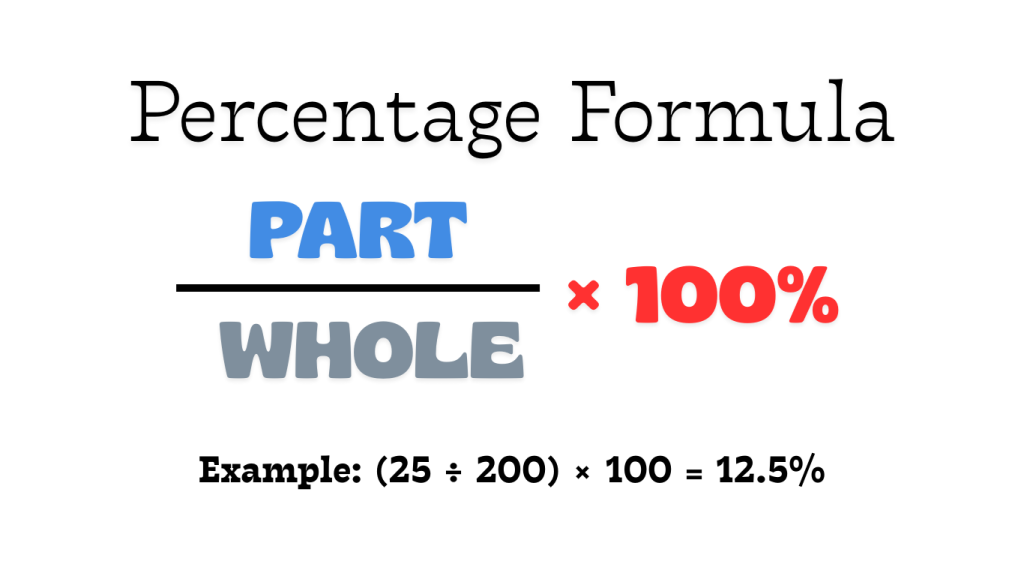
As you have seen in the previous paragraphs about what each tools does here you will have some examples how they are calculates manually with examples from everyday life. All of the calculations related to the percentage are based on the core formula that is shown in the image below, but along with some variations for some specific calculations like discounts, increase and others. Below you will have two example that are finding a percentage of a whole and finding the percentage of discount.
Example 1: Finding a Percentage of a Whole
A student in his exam has scored 68 out of 80. Here we need to find his percentage.
Formula: (Points gained / Total Points) * 100 Manual calculation : (68 / 80) * 100 = 0.85 * 100 = 85%
Example 2: Finding the amount of discount from percentage
A clothing shop has done a 45% discount on some items and of them is is $80. Now we find how much is the discount.
Formula: percentage as decimal * the total price Manual Calculation: (45 / 100) * 80 = 0.45 * 80 = $36 off
Frequently Asked Questions (FAQs)
1. What does the word “percent” actually mean?
The word percent comes from the Latin phrase per centum, which means “out of one hundred.” In simple terms, a percentage shows how many parts there are out of 100.
2. Can a percentage be more than 100%?
Yes. A value of 100% represents the full original amount, but percentages can go higher. For example, 200% means twice the original value, and 150% means one and a half times the original.
3. What is the basic formula for calculating a percentage?
The simplest formula is: (Part ÷ Whole) × 100
This shows what portion of the total a specific value represents, expressed as a percentage.
4. How do I calculate a percentage of a number?
First, convert the percentage into a decimal by dividing it by 100. Then multiply that decimal by the number.
Example: To find 20% of 80 → 0.20 × 80 = 16
5. Are percentages reversible?
Yes, percentages can be reversed. For example, 8% of 50 gives the same result as 50% of 8 — both equal 4.
6. What’s a quick way to find 10% or 1% of a number?
- To find 10%, move the decimal point one place to the left.
Example: 10% of 150 is 15. - To find 1%, move the decimal point two places to the left.
Example: 1% of 150 is 1.5.
7. What is the “swap trick” for percentages?
The swap trick is a mental math shortcut. It works because percentages are reversible.Instead of calculating 8% of 50, you can swap the numbers and calculate 50% of 8, which is much easier — half of 8 is 4.
REFERENCE
The percentage calculators on this page are based on standard mathematical definitions and explanations from trusted educational resources: