
Percentage Change Calculator is a tool that helps you quickly find how much a value has increased or decreased in relation to its original value. Whether you are comparing prices, test scores, population changes, or everyday measurements, this tool shows the percent increase or decrease in seconds. Simply enter the original value and the new value to see the percentage change directly.
What Is a Percentage Change?
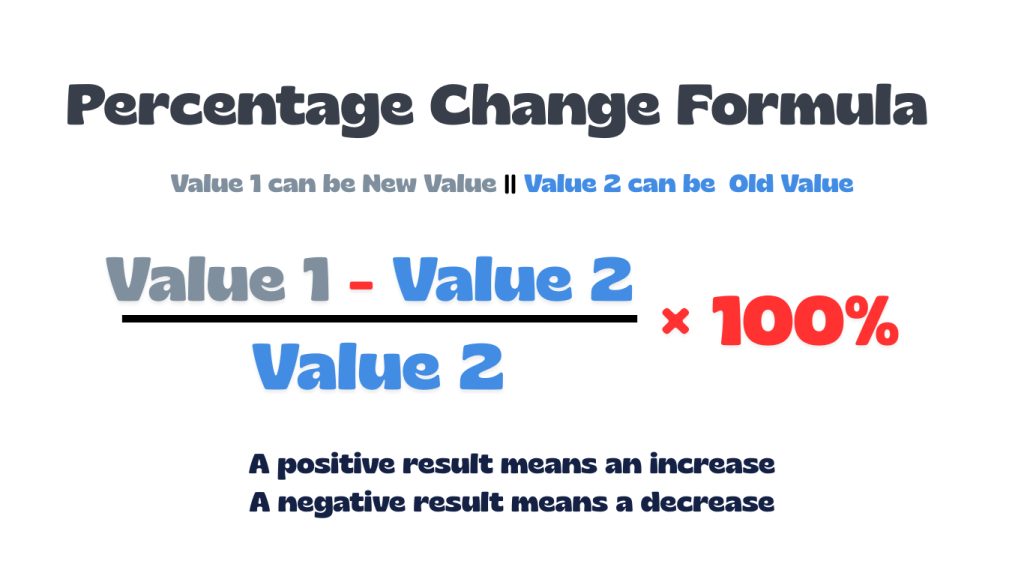
Percentage change is indicates if a value has increased or decreased compares to its original value. The calculation is done by firstly by subtracting the original value from the new value, then diving the result by the original value and in the end multiplying the result by 100. There 2 results than can be outputted, one is positive number which means an increase and a negative number indicates a decrease. This approach is widely used for understanding growth or loss in fields like data analysis, sales and finance. An example can be a sales increase from 400$ to 500$, the 100$ difference shows a 25% increase.
Why Percentage Change Is Important
Percentage change is crucial method because it shows relative increase or fall rather than just absolute numbers. It helps and makes it easier to compare results, spot changes over time, and make smart decisions in finance, work, and everyday situations. . Percentage change makes data easier to understand and act upon by clearly displaying both the size and direction of change, going beyond raw numbers.
Because change is represented as percentage, it becomes more easier and clear to spot if the difference is major or minor one. For example, if an increase indicates significant growth or minor change. Additionally, percentage change makes it possible to fairly compare values of various sizes, tracks trends over time, and promotes wiser choices in areas such as budgeting, discounts, economic research, and investment
Percentage Change Formula
Percentage Increase vs Percentage Decrease
Percentage increase and decrease are both related and covered by percentage change by using the formula give in the image above. Depending on the output from the formula when a positive results is calculates it means an increase, and when it is a negative results it means a decrease. The negative result or percentage decrease is also usually written as positive percentage decrease (e.g., -30% = 30% decrease).
The key difference between percentage increase and decrease is the course of change that whether it goes up or down. To make simpler to remember and when percentage increase and decrease happens related to percentage change keep in mind the below note:
Percentage increase : it happen when the new values is bigger than original value, the percentange change is positive (for example, going from 10 to 15 is a 50% increase).
Percentage decrease : it happens when the new value is smaller than the original value, the percentage change is negative (for example, going from 15 to 10 is a 33.33% decrease).
Absolute Change vs Percentage Change
Absolute change is an simple difference between two values that are the new value and original value, and tells if amount is increased or decreased in real units. On the other hand, percentage change indicates the size of the difference between the new and original value that is expressed as a percentage. While percentage change indicates the impact of the change in relation to your starting point, absolute change indicates the size of the change. . For changes between percentages, absolute change is expressed in percentage points and as example can be taken interest rate.
Percentage Change vs Percentage Difference
The percentage difference displays the differences between the two values are without indicating an increase or decrease, compares them without a start or end, and utilizes the average of both as the base. On the other hand, percentage change needs and uses a starting value and an ending value so it can indicates how much a value has gone up or down over the time, and also uses a base value. You have to use percent change for situations like before and after or goes from old to new, and percentage difference when comparing 2 similar values at the same time.
How the Percentage Change Calculator Works
A percentage change calculator determines how much a value has increased or decreased in percentage terms by comparing the original and new value. It does these by calculating the difference between the two values, then dividing the result by the initial value and in the end it multiplies the result by 100. If the final result is positive number it indicates a increase, and if the result is negative it indicates a decrease (also said as positive percentage decrease). Below you have 2 examples that are done manually that also apply to our percent change calculator.
How to Calculate Percent Change Step-by-Step Manual Calculation
The below two examples are on how to calculate percent change in both cases when it is a decrease or an increase. They both are shown the step by step calcualtion.
Example 1 : A price goes from $40 to $50.
- Step 1 – Find the difference => 50 − 40 = 10
- Step 2 – Divide by the original value => 10 ÷ 40 = 0.25
- Step 3 – Convert to percentage => 0.25 × 100 = 25%
Result: These is a percentage increase and the price increased by 25%
Example 2 : A score goes from 80 to 60.
- Step 1 – Find the difference => 60 − 80 = −20
- Step 2 – Divide by the original value => −20 ÷ 80 = −0.25
- Step 3 – Convert to percentage => −0.25 × 100 = −25%
Result: These is a percentage decrease and the score decreased by 25%.
Common Mistakes to Avoid
When calculating percentage change one of the most common mistakes is dividing by the incorrect number like using the new value instead of original one. Other ones can be to forget to multiply by 100, adding incorrectly more percentage change, mistaking percentage points for percentage change, and forgetting to consider whether the outcome is positive or negative. You have to keep in mind that always divide by the original value, to convert into percentage, and to clearly indicate if it is a increase or decrease. Since division by zero is undefinable, changes from zero cannot be stated as a percentage.
Why Use a Percentage Change Calculator?
One of the key reasons to use a percent change calculator is that is helps you quickly calculate how much a value has changed from its initial value. Also, it reduces calculation mistakes when done manually, saves time, it provides clearer insights than just looking in absolute differences alone. It helps for better decision making and makes data sets comparison more simple by displaying both the size and the direction of change. In order to interpret trends and understand changes in the actual world, this tool is frequently used in academics, science, finance, shopping, personal budgeting, and data analysis.
Common Uses of Percentage Change Calculator
As you may have understood that the percent change calculator helps you to evaluate how much a number has increased or decreased. It makes the calculation process more faster, reduces mistakes, makes trends more simple to understand and helps in making better decision in different fields like science, finance education, etc. Below you will have a list of some common use cases per the percent change calculator.
- Finance & Economics: Used to Track stock price changes, measuring revenue or profit growth, and evaluating spending increases/decreases.
- Retail & Sales : Used to calculate discounts and savings, monitoring sales growth or decline, checking profit or loss on items.
- Science & Health : Helps in tracking population growth, measuring experiment change, monitoring health metrics (weight, blood pressure).
- Education & Personal Use : Helps in checking percentage change in grades, tracking fitness progress, comparing before-and-after values in everyday life.
When Not to Use Percentage Change
When the initial number is zero, negative, or extremely small, the percentage change may be misleading since the conclusions may be unclear or overstated. When comparing percentages themselves it not ideal and is suggested to use percentage points, also when based are significantly different or when there are sequential percentages changes in not recommended. It is less helpful for data that doesn’t have a real zero or equal scale, such as ratings, and where the context and actual numbers are more important than the relative change.
Frequently Asked Questions (FAQs)
1. Can a percentage change be negative?
Yes. A negative result shows a decrease, meaning the new value is smaller than the original. A positive result indicates an increase.
2. How do I calculate a percentage change if the original value is zero?
The calculation is undefined because dividing by zero is mathematically impossible.
3. What is the difference between percentage change and “percentage points”?
Percentage points show the simple difference between two percentages (e.g., 10% to 15% is a 5-point increase). Percentage change measures the relative change (10% to 15% is a 50% increase).
4. Can a percentage decrease be more than 100%?
Yes, mathematically. This happens when the final value drops below zero. For example, a profit falling from $100 to -$50 is a 150% decrease.
5. How do I use a calculator for a “percentage of a percentage” change?
Treat percentages like regular numbers in the formula. For instance, a market share rising from 2% to 3% is (3 − 2) ÷ 2 × 100 = 50.
6. What does a 200% increase actually mean?
7. A 100% increase doubles the value. A 200% increase triples it—adding twice the original amount.
8. How do I calculate a percentage change between two negative numbers?
Yes. Use the absolute value of the original number in the formula: (𝑉2 − 𝑉1) ÷ ∣𝑉1∣ × 100. For example, moving from -10 to -25 is a 150% decrease.
9. How is percentage change used to calculate profit and loss?
In business, it shows your gain or loss by comparing purchase and sale prices.
10. Does the calculator automatically detect increase or decrease?
Yes. Positive results are shown as an increase and negative results are shown as a decrease.
11. How is percentage change used in finance?
Investors track stock performance, currency fluctuations, or asset growth using percentage change.
12. Can it calculate growth over time?
Yes. Divide the total percentage change by the number of periods (months, years, etc.) to find the average change over time.
Explore More Percentage Tools
Explore more percentage calculators to help with different types of percentage problems from our site. Our tools are designed to make it easy to work out with percentage increase, decrease, change, difference, and much more tools that are only related to percentage calculations. Click any calculator below to continue solving percentage questions quickly and accurately.
Percentage Increase Calculator
Measures how much a value has gone up from its original amount, expressed as a percent.
Percentage Decrease Calculator
Measures how much a value has gone down from its starting amount as a percentage.
Percentage Difference Calculator
Calculates the percent difference between two numbers by comparing how far they are from each other.
REFERENCE
The percentage change calculator on this page is based on standard mathematical definitions and explanations from trusted educational resources: