
Percentage Increase Calculator helps you quickly find how much a value has grown from its original amount. You don’t need to do the math yourself, this tool shows the increase as a percentage, so you can easily see how big the change is. It’s useful for prices, test scores, sales, populations, and any situation where something has gone up over time. By entering the old value and the new value, the calculator instantly tells you the percentage increase , making it simple to understand.
What Is Percentage Increase?
Percentage Increase indicates how much a values has increased in comparison to its initial value, which is shown as part of 100. It makes it simpler to compare changes across various sizes or time periods by displaying growth in relative terms. In different areas like business, finance, employment, and statistics the percent increase is widely used as an indicator of growth, including price adjustments, pay increase, growth in populations and investment returns.
As an example of increase can be going from 80$ to 100$ which is 25% increase, while going from 1 to 2 is 100% increase. Percent increase shows how big a change can really be, not just how much a number went up. Also, it helps people to have a much better understanding of growth, trends, and relative impact.
How Percentage Increase Works
Percent increase works firstly by calculating the difference between original and new values, then divides the difference by the initial value. Then the final result is converted to a percentage by multiplying it by 100. This approach makes it simpler to determine if a change is minor or a big one by placing growth in context. Percentage increase is often used in data analysis, demographic research, business growth, and finance since it compares change to the starting point.
Percentage Increase Formula
The formula of the percentage increase shows us the growth of a value compares to its initial value. It determines how much the new and original values differ, divides that difference by the original value, and then gives us the result converted into a percentage. This allows a clear and consistent understanding of growth.
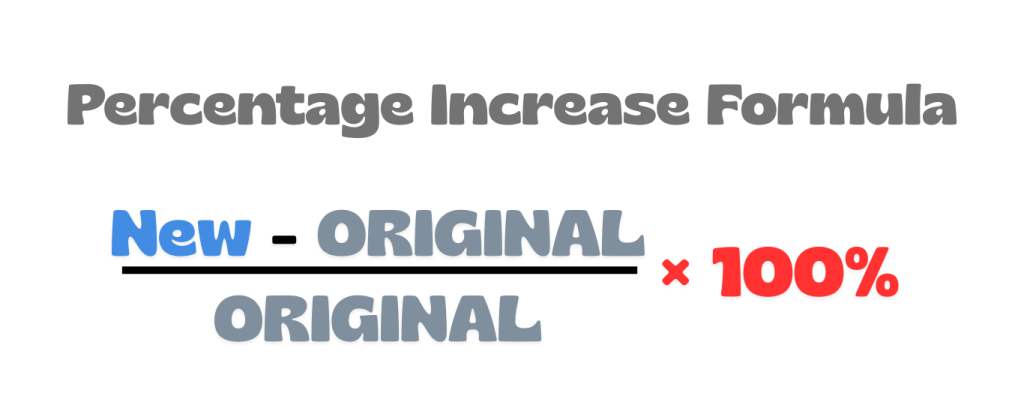
How to Calculate Percentage Increase (Step-by-Step)
To calculate it we need the formula shown in above image, the new and original value and then starting to calculate it. Below you will have an example with each step and formula applied.
Example:
A product increased from 95$ to 120$.
- Step 1: Find the difference between values => 120 – 95 = 25$
- Step 2: Divide by the original value => 25 / 95 = 0.263
- Step 3: Multiply by 100 => 26.3 % increase
When to Use a Percentage Increase Calculator
As we have said before the percent increase is used when you want to find how much the value has grown compared to the initial value, which our percentage increase calculator exactly does. It is very helpful in fields like finance, personal budgeting, education, data analysis, and business, because it demonstrates growth not only in absolute terms but also in relative terms.
Typical applications include tracking sales or investment growth, figuring out raises in salaries, keeping an eye on growing expenses or prices, estimating performance achievements, and examining demographic or statistical trends. Use it whenever you need to represent the increase as a clear percentage for simple comparison between an initial value and a higher final value.
Percentage Increase vs Percentage Decrease
Percentage increase and descrease use the same core formula to define the relative change between the initial value and the new one. The direction of change is where the differences are found. When the result are positive and shows a percentage increase when the new value is greater than the initial one. On the other side, when the result is negative and shows a percentage decrease when the new value is smaller, which can also be expressed as a positive decrease value. Because the calculations are always based on the initial value , in all the cases the comparison is reliable and informative.
Percentage Increase vs Percentage Change
Percentage change is a general term the refers how a value changes in relation to its initial value, which may lead to either an increase or a decrease. One specific kind of percentage change which is part of it is the percentage increase that only happens when the new value is bigger than the initial value, by offering a positive outcome. They both compare the change to the initial value using the same method. The main difference is the scope, percentage change includes all relative change, while percentage increase relates only to positive growth.
Common Mistakes to Avoid
Some common mistakes in percentage increase calculations may raise from using the incorrect base values, skipping or forgetting to multiply by 100, or mistaking percentage points for percent change. One of the main and most important rules is that evert time to divide by the initial value not the new one. When percentages are added directly rather than applied step-by-step, several errors also occur. Having a clear information on which value is the original one and which is the new value helps in preventing incorrect results and doing correct percentage increase calculation.
Why to Use an Percentage Increase Calculator
Our percentage increase calculator saves you time and raises accuracy by removing human manual calculations mistakes. It makes it simpler to compare growth in business, finance, education, and data analysis by easily converting value changes into understandable percentages. Percent increase calculator allows users to have a better understanding in trends and make well informed decisions without the need of complicated math due to its clear inputs and quick results. Because of this, it is perfects for both regular daily checks and expert analysis when accuracy is crucial.
Frequently Asked Questions (FAQs)
1. What if the result is a negative number?
A negative result means the value went down, not up. This is called a percentage decrease, not an increase. But Our Tool will tell what it is.
2. What does a 100% increase mean?
A 100% increase means the value has doubled.
A 200% increase means it has tripled.
3. What’s the difference between “percentage” and “percentage points”?
Percentage points are the simple difference between two percentages (for example, from 10% to 12% is a 2-point increase).
Percentage increase shows how much the value grew relative to the original amount (10% to 12% is actually a 20% increase).
4. Can a percentage increase be more than 100%?
Yes. If a value more than doubles, the increase is over 100%. For example, going from $3 million to $30 million is a 900% increase.
5. What if the starting value is zero?
You can’t calculate a percentage increase from zero because dividing by zero isn’t possible. In real reports, this is usually marked as N/A or infinite increase.
6. What is the most common mistake people make?
The most common error is dividing by the new value instead of the original value. Always use the starting number as your base.
7. Is “percentage change” the same as “percentage increase”?
Not exactly. Percentage change is a general term that includes both increases and decreases. Percentage increase only applies when the value goes up.
8. Should I round numbers during the calculation?
No. Wait until the final step to round your result. Rounding too early can cause inaccurate results.
9. Is a 50% increase followed by a 50% decrease the same as no change?
No. If $100 increases by 50%, it becomes $150. A 50% decrease from $150 brings it down to $75 — not back to $100.
10. How do I find the original value if I know the final value and the percentage increase?
Divide the final value by (1 + percentage as a decimal). Example: If $120 includes a 20% increase, the original value was $100.
Explore More Percentage Tools
Explore more percentage calculators to help with different types of percentage problems from our site. Our tools are designed to make it easy to work out with percentage increase, decrease, change, difference, and much more tools that are only related to percentage calculations. Click any calculator below to continue solving percentage questions quickly and accurately.
Percentage Decrease Calculator
Measures how much a value has gone down from its starting amount as a percentage.
Percentage Change Calculator
Finds how much a value has increased or decreased from its original value in percentage terms.
Percentage Difference Calculator
Calculates the percent difference between two numbers by comparing how far they are from each other.
REFERENCE
The percentage increase calculator on this page is based on standard mathematical definitions and explanations from trusted educational resources: