
Our Reverse Percentage Calculator helps you find the original value of an item or amount before a percentage increase or decrease was applied. Whether it’s a product on sale, a salary increase, or tax included in a price, this tool works backward from the final value to calculate the base amount. It saves time, reduces errors, and ensures accurate calculations for shopping, finance, business, and everyday situations.
What Is a Reverse Percentage?
To determine an amount’s initial value just before to a percentage increase or decrease, it is used the reverse percentage method. These method determines the initial 100% value by calculating backwards from the final value, instead of computing e percentage of a known value. It is often used to determine initial pricing before the discounts, salaries before increase, or values prior to growth or decrease.
The calculation can be performed using a decimal multiplier or by determining the final percentage and dividing the final amount by that percentage. As examples can be taken a 80% following a 15 percent discount or 120% following a 20% increase. When reversing percentage changes, reverse percentage calculations helps in preventing typical errors and guarantee accurate results. These can be also done with our Reverse Percentage Calculator.
Why Reverse Percentages Are Important
Reverse percentage are very crucial when we need to find the original value before when a percentage increase or decrease has been applied. They are commonly used in retail when it needed to find pricing before markups or discount are applied, in finance when we need to calculate per-tax amounts and initial investments. Also, reverse percentage can be used in data analysis to precisely analyze percentage change.
Reverse percentages provide precise results in real-world applications like commercial decisions, economic research, and aptitude tests and can help avoid frequent arithmetic errors like adding or subtracting percentages from a final total, which is one of the reasons we have created the reverse percentage calculator.
Common Situations Where Reverse Percentages Are Used
Reverse percentage method is commonly used when we know the final value after where is applied a percentage increase or decrease and is needed to find the original value. This method is often used to precisely reverse percentage changes and remain clear of typical calculation errors in daily computations, corporate choices, and financial analysis. Below you have list some common situations when it is used.
- Retail and Discounts: Finding the original price of an item before a sale or discount was applied.
- Taxes and VAT: Calculating the base price of a product before sales tax or VAT was added.
- Salaries and Income: Determining a previous salary before a percentage increase or raise.
- Finance and Investments: Finding the original investment amount before interest or returns were applied.
- Everyday Calculations: Finding total fuel capacity or usage when only a percentage is known.
Why Reverse Percentages Are Often Confusing
One of the reasons that reverse percentages seem confusing is the process of the method that requires to go backwards to calculate it, like from a changed value in finding the original amount, which is against common sense or intuition. Since the new number no longer represent 100% of the initial value, a lot of people try to revert the percentage change by removing or adding the same percentage value, which is wrong. This problem often results from misinterpreting what the “whole” is, calculating percentages of incorrect numbers, and forgetting to convert percentages into decimal multipliers. Instead of trying to immediately reverse the percentage, you must determine what percentage the new result represents and divide by that amount in order to calculate in the right away.
What Is a Reverse Percentage Calculator?
Our reverse percentage calculator is a tool that can be used to determine the initial value before applying a percentage increase or decrease. Our calculator determines the initial 100% value by working backwards from the known final value and percentage change rather than calculating the percentages of the number. Our reverse percentage calculator quickly and precisely determines the initial price, salary, or value by dividing the final value by the right percentage multiplier. These tools is commonly used to remove markups, reverse discounts, remove tax or VAT, and analyze percentage based changes without human errors.
When Do You Need Reverse Percentage Calculator?
As you have read before of the main purpose what the reverse percentage calculator does in these part you will some of the cases when you might needs it. Some common situations where a reverse percentage calculator is useful include:
- Sales and Discounts: Finding the original price of an item before a discount was applied.
- Tax and VAT Removal: Calculating the base price of a product before sales tax or VAT was added.
- Finance and Investments: Determining the initial investment value after a percentage gain or loss.
- Salary Adjustments: Finding a previous salary before a percentage raise or increase.
- Business Pricing: Reversing markups or price increases to identify original costs.
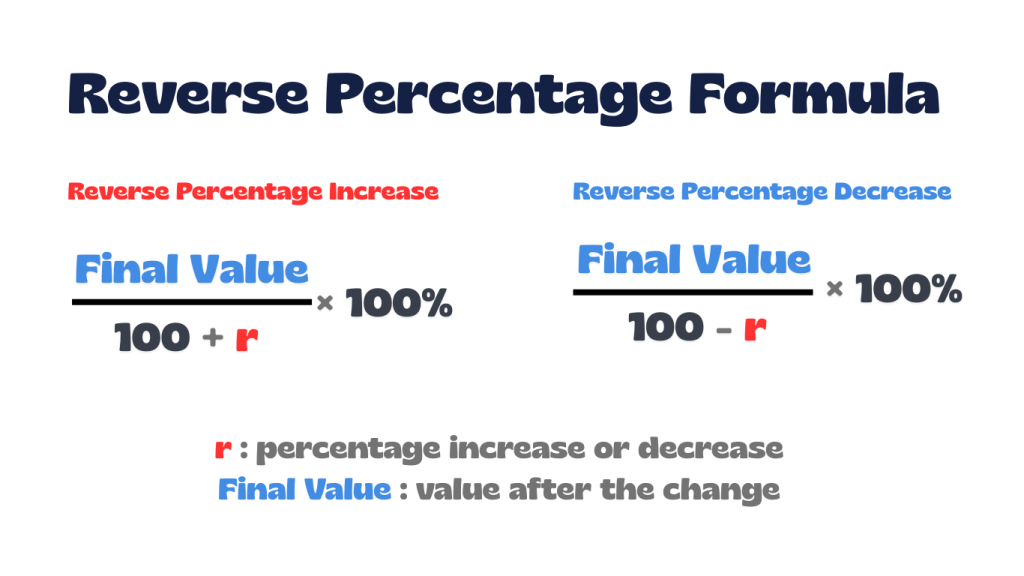
Reverse Percentage Formula
How to Calculate Reverse Percentage?
To calculate the reverse percentage you need to follow some steps which will be below. Also to have a better understanding on how to apply them in real life you have some example.
Step 1: Determine the percentage the current value represents:
- For a decrease: subtract the percentage reduction from 100%
- For an increase: add the percentage increase to 100%
Step 2: Divide the current value by this percentage : This gives the value of 1% of the original amount.
Step 3: Multiply by 100: This gives the original 100% value.
Step-by-Step Examples
Example 1: Price After a Discount => A jacket costs £60 after a 25% discount. What was the original price?
- Step 1: 100% − 25% = 75% → £60 represents 75% of the original price
- Step 2: £60 ÷ 75 = £0.80 (1% of original price)
- Step 3: £0.80 × 100 = £80
- Answer: Original price was £80
Example 2: Price Including VAT = > A toaster costs £30 including 20% VAT. What was the price before VAT?
- Step 1: 100% + 20% = 120% → £30 represents 120% of the original price
- Step 2: £30 ÷ 120 = £0.25 (1% of original price)
- Step 3: £0.25 × 100 = £25
- Answer: Price before VAT was £25
Difference Between Percentage Change and Reverse Percentage
Between the percentage change and reverse is a relations but they serve different purposes. When both the initial and new value are known, percentage change calculates how much the value has changed. An example of the percentage change can be when the price of product increase from $20 to $25 which is a 25% percentage change. On the other hand, when the final value and the percentage change are available, reverse percentage does it work by going backwards to get the initial value. As an example can be the when a shirt once was priced at $20 and costs $25 which follows with a 25% increase. The main difference of both of them is that reverse percentage goes backwards from the final value while percentage change goes forward from the starting value.
Common Mistakes in Reverse Percentage Calculations
One of the common mistakes that happens when calculating reverse percentage is when people attempt to do the backward calculation in a wrong way. Applying the percentage change to the final value without realizing that it reflects more or less than 100% of the initial value is also a common mistake. Other common mistakes include considering that the new number is 100%, calculating the decimal multiplier incorrectly, or believing that an increase and decrease of the same proportion cancel each other out. To avoid these mistakes use our Reverse Percentage Calculator.
Why Use a Reverse Percentage Calculator?
The reverse percentage calculator is useful to calculate pre-sale prices, pre-tax costs, or the original amount prior to profit margins or inflation adjustments. These tool helps you ensure accuracy when calculating the values that manual calculations can lead to mistakes. Also, it saves times and reduces errors by eliminating step by step manual calculations. Reverse percentage calculator can help business with insights which helps in analyzing costs, pricing and profit margins. Use our tool to avoid some of these mistakes to have accurate and fast results.
Frequently Asked Questions (FAQs)
1. Why can’t I just add the percentage back?
If a price is reduced by 20%, the new price represents 80% of the original. Simply adding 20% to the reduced price calculates 20% of that smaller amount, giving an incorrect result.
2. How can I find the original value without reverse percentage calculator?
Use the Unitary Method: Treat the final amount as its current percentage (e.g., £24 = 80%), divide to find 1% (£24 ÷ 80 = £0.30), then multiply by 100 to get the original value (£30).
3. Can I use reverse percentages for taxes like VAT or GST?
Yes. If a price includes 20% VAT, it represents 120% of the original cost. Divide the total price by 1.2 to get the pre-tax amount.
4. How do businesses use reverse percentages?
Companies often use reverse percentages to calculate original costs, margins, or markups. For example, if they know current revenue and profit margin, they can determine the original cost of goods sold.
5. Can reverse percentages be applied to population or statistics?
Yes. If a city has 9.3 million people, which is 14% of the country, dividing 9.3 million by 0.14 gives the total population.
6. What if the result has too many decimal places?
For real-life situations like money, round to two decimal places. For math exercises, follow instructions on significant figures or fractions.
7. How do I handle percentages of percentages in reverse calculations?
If 20% of 15% of a number equals 6, divide 6 by 0.20 to get 30, then divide 30 by 0.15 to find the original total: 200.
8. Can reverse percentages help with inflation or year-on-year changes
Yes. To find last year’s equivalent value, divide the current amount by 1 plus the inflation rate. For 5% inflation, divide by 1.05.
9. Can reverse percentages help calculate gross pay from net pay?
Yes. If your net salary is 80% of your gross, divide your take-home pay by 0.80 to find the gross amount before deductions.
Explore More Percentage Tools
Explore more percentage calculators to help with different types of percentage problems from our site, like the Reverse Percentage Calculator. Our tools are designed to make it easy to work out with percentage increase, decrease, change, difference, and much more tools that are only related to percentage calculations. Click any calculator below to continue solving percentage questions quickly and accurately.
Markup Calculator
Shows how much you need to add to your cost price to reach a desired selling price or profit percentage.
Margin Calculator
Helps you quickly find profit margin, profit, cost, or revenue by comparing selling price against costs.
Percentage Change Calculator
Finds how much a value has increased or decreased from its original value in percentage terms.
REFERENCE
The Reverse Percentage Calculator on this page is based on standard mathematical definitions and explanations from trusted educational resources: